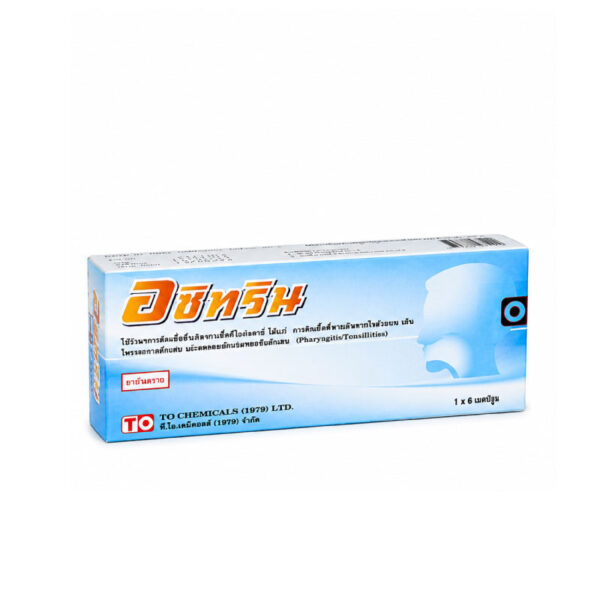
TO AZITHRIN (Azithromycin) 250 mg 6 Tablets
Azithromycin 250 mg เป็นยาปฏิชีวนะกลุ่ม macrolide/azalide ออกฤทธิ์ยับยั้งการสร้างโปรตีนของแบคทีเรียโดยจับกับ 50S ribosomal subunit ใช้รักษาการติดเชื้อแบคทีเรียที่ไวต่อยา เช่น การติดเชื้อทางเดินหายใจ ผิวหนัง และ Chlamydia บางกรณี โดยควรใช้ตามข้อบ่งใช้และแนวทาง antimicrobial stewardship ที่เหมาะสม
ข้อสังเกตสำคัญเกี่ยวกับรูปแบบยา: แม้ชื่อสินค้าที่ส่งมาระบุ “6 Tablets” แต่ฐานข้อมูล อย. ไทยระบุผลิตภัณฑ์ AZITHRIN 250 mg ของบริษัท ที.โอ.เคมีคอลส์ (1979) จำกัด เป็น hard capsule ไม่ใช่ tablet ดังนั้นรายละเอียดผลิตภัณฑ์ด้านล่างจะยึดรูปแบบยาที่ตรวจสอบได้จากทะเบียนไทยเป็นหลัก. (ข้อมูลยาแห่งชาติ)
การออกฤทธิ์
Azithromycin เป็นยาปฏิชีวนะกลุ่ม azalide ซึ่งอยู่ในกลุ่ม macrolides ออกฤทธิ์โดยจับกับ 23S rRNA ของ 50S bacterial ribosomal subunit ทำให้กระบวนการ translocation และการสร้างโปรตีนของแบคทีเรียถูกยับยั้ง
ฤทธิ์โดยทั่วไปเป็น bacteriostatic แต่สามารถมี bactericidal activity ต่อเชื้อบางชนิดเมื่อระดับยาเพียงพอ
Azithromycin มีคุณสมบัติเด่นคือกระจายเข้าสู่เนื้อเยื่อและ intracellular compartments ได้ดี และมี tissue half-life ยาว ทำให้สามารถใช้ regimen แบบวันละครั้งและคอร์สสั้นในหลายข้อบ่งใช้ได้. (Medicines.org.uk)
ขอบเขตการทำลายเชื้อ
Azithromycin มีฤทธิ์ต่อเชื้อ Gram-positive, Gram-negative และ atypical bacteria บางชนิด แต่ความไวของเชื้อแตกต่างตามภูมิภาคและการดื้อยา
เชื้อที่อาจไวต่อ Azithromycin ได้แก่ Streptococcus pyogenes, Streptococcus pneumoniae บางสายพันธุ์, Haemophilus influenzae, Moraxella catarrhalis, Chlamydia trachomatis, Mycoplasma pneumoniae, Legionella pneumophila และ Mycobacterium avium complex ตามข้อบ่งใช้และ susceptibility. (Medicines.org.uk)
อย่างไรก็ตาม macrolide resistance พบได้ในเชื้อหลายชนิด โดยเฉพาะ pneumococci และเชื้อที่ก่อโรคติดต่อทางเพศสัมพันธ์บางชนิด จึงควรพิจารณาข้อมูล resistance ในพื้นที่และผลตรวจ microbiology เมื่อเหมาะสม
สำหรับ Neisseria gonorrhoeae มีความเป็นไปได้สูงที่จะดื้อ macrolides จึงไม่ควรใช้ Azithromycin เดี่ยวเพื่อรักษา uncomplicated gonorrhoea เว้นแต่มีข้อมูลยืนยันความไวและใช้ร่วมกับ antibacterial agent ที่เหมาะสมตามแนวทาง. (Medicines.org.uk)
เภสัชจลนศาสตร์
Azithromycin ถูกดูดซึมหลังรับประทานและกระจายเข้าสู่เนื้อเยื่อได้กว้าง โดยระดับยาในเนื้อเยื่อหลายแห่งสูงกว่าระดับในพลาสมาอย่างมาก
ยามี protein binding ที่ขึ้นกับระดับความเข้มข้น และมี apparent volume of distribution สูง สะท้อนการกระจายเข้าสู่เนื้อเยื่ออย่างกว้างขวาง
Azithromycin ถูกกำจัดทางน้ำดีเป็นหลักในรูป unchanged drug และมีการกำจัดทางไตในสัดส่วนที่น้อยกว่า
ยามี terminal elimination half-life ยาวประมาณ 2–4 วัน ซึ่งสัมพันธ์กับการสะสมและการปลดปล่อยออกจากเนื้อเยื่ออย่างช้า ๆ
ในผู้ที่มี severe renal impairment โดยเฉพาะ GFR <10 mL/min systemic exposure อาจเพิ่มขึ้น จึงต้องใช้ด้วยความระมัดระวัง. (Medicines.org.uk)
ข้อห้ามใช้
ห้ามใช้ในผู้ที่แพ้ Azithromycin, erythromycin, macrolide antibiotics, ketolides หรือส่วนประกอบของยา. (Medicines.org.uk)
ควรหลีกเลี่ยงการใช้ร่วมกับ ergot derivatives เนื่องจากมีความเสี่ยงทางทฤษฎีต่อ ergotism และ SmPC ที่ใช้อ้างอิงไม่แนะนำให้ใช้ร่วมกัน. (Medicines.org.uk)
ผู้ที่เคยเกิด cholestatic jaundice หรือ hepatic dysfunction ที่เกี่ยวข้องกับการใช้ Azithromycin ควรได้รับการประเมินอย่างระมัดระวังก่อนใช้ซ้ำ
ข้อความระวัง
อาจเกิด severe hypersensitivity reactions เช่น anaphylaxis, angioedema รวมถึง severe cutaneous adverse reactions เช่น Stevens–Johnson syndrome, toxic epidermal necrolysis, DRESS และ AGEP หากเกิดผื่นรุนแรง แผลพุพอง หรืออาการแพ้รุนแรงควรหยุดยาและรับการรักษาทันที. (Medicines.org.uk)
Azithromycin มีรายงาน hepatotoxicity และ fulminant hepatitis ซึ่งบางกรณีรุนแรงถึง liver failure หากมีตัวเหลือง ตาเหลือง ปัสสาวะเข้ม อ่อนเพลียมาก หรือมี bleeding tendency ควรหยุดยาและประเมิน liver function. (Medicines.org.uk)
อาจทำให้ QT interval prolongation และ torsades de pointes จึงควรระวังในผู้ที่มี congenital/acquired long QT, hypokalaemia, hypomagnesaemia, bradycardia, heart failure หรือใช้ยาที่ prolong QT ร่วมด้วย. (Medicines.org.uk)
มีรายงานว่า Azithromycin อาจทำให้ myasthenia gravis แย่ลง หรือทำให้เกิด myasthenic syndrome ขึ้นใหม่. (Medicines.org.uk)
เช่นเดียวกับยาปฏิชีวนะอื่น อาจเกิด Clostridioides difficile-associated diarrhoea ซึ่งมีตั้งแต่ท้องเสียเล็กน้อยจนถึง colitis รุนแรง. (Medicines.org.uk)
การใช้ยาในระยะตั้งครรภ์และให้นมบุตร
การตั้งครรภ์: มีข้อมูลจากการตั้งครรภ์ที่ได้รับ Azithromycin จำนวนมาก และส่วนใหญ่ไม่พบการเพิ่มความเสี่ยงของ major congenital malformations อย่างชัดเจน อย่างไรก็ตามควรใช้ เมื่อมีความจำเป็นทางคลินิก และแพทย์ประเมินว่าประโยชน์มากกว่าความเสี่ยง. (Medicines.org.uk)
การให้นมบุตร: Azithromycin ถูกขับเข้าสู่น้ำนมได้ ทารกที่ได้รับนมแม่อาจมีอาการ เช่น ท้องเสีย candidiasis ของเยื่อบุ หรือ hypersensitivity จึงควรพิจารณาประโยชน์ของการให้นมเทียบกับความจำเป็นของการรักษาในมารดา. (Medicines.org.uk)
อาการข้างเคียง
อาการที่พบได้บ่อย ได้แก่ ท้องเสีย ปวดศีรษะ คลื่นไส้ อาเจียน และปวดท้อง. (Medicines.org.uk)
อาจพบเบื่ออาหาร เวียนศีรษะ ง่วงซึม dyspepsia ท้องอืด ผื่น คัน หรือค่าการทำงานของตับผิดปกติ
อาการสำคัญที่ต้องระวัง ได้แก่ anaphylaxis, severe skin reactions, hepatotoxicity, QT prolongation, torsades de pointes, ventricular arrhythmia, C. difficile-associated diarrhoea และ myasthenia gravis exacerbation. (Medicines.org.uk)
การได้รับยาเกินขนาด
อาการ overdose มักสอดคล้องกับ adverse effects ของยาที่รุนแรงขึ้น เช่น คลื่นไส้ อาเจียน ท้องเสีย และการสูญเสียการได้ยินชั่วคราว
ไม่มี specific antidote
การรักษาเป็นแบบ supportive และ symptomatic พร้อมประเมิน fluid/electrolyte balance, liver function และ ECG ตามอาการและปริมาณยาที่ได้รับ
ปฏิกิริยาระหว่างยา
ยาที่ทำให้ QT prolongation: เช่น quinidine, procainamide, amiodarone, sotalol, citalopram, pimozide, moxifloxacin, levofloxacin, chloroquine และ hydroxychloroquine อาจเพิ่มความเสี่ยง ventricular arrhythmia. (Medicines.org.uk)
Digoxin: Azithromycin ยับยั้ง P-glycoprotein และอาจเพิ่มระดับ digoxin จึงควรติดตามอาการและระดับยาเมื่อเหมาะสม. (Medicines.org.uk)
Colchicine: อาจเพิ่ม colchicine exposure จึงต้องระวัง toxicity โดยเฉพาะผู้สูงอายุหรือ renal impairment. (Medicines.org.uk)
Ciclosporin: อาจเพิ่ม ciclosporin exposure ควรติดตามระดับยาและปรับขนาดเมื่อจำเป็น. (Medicines.org.uk)
Warfarin และ coumarin anticoagulants: มี post-marketing reports ของ anticoagulant effect เพิ่มขึ้น จึงควรพิจารณาติดตาม PT/INR ถี่ขึ้น. (Medicines.org.uk)
Statins: แม้ Azithromycin มี CYP3A4 inhibition น้อยกว่า clarithromycin แต่มีรายงาน rhabdomyolysis เมื่อใช้ร่วมกับ statins จึงควรระวังอาการปวดหรืออ่อนแรงของกล้ามเนื้อ. (Medicines.org.uk)
Ergot derivatives: ไม่แนะนำให้ใช้ร่วมกัน เนื่องจากมีความเสี่ยงต่อ ergotism. (Medicines.org.uk)
ชื่อและความแรงของยา (Drug Name and Strength)
Azithromycin 250 mg per hard capsule
ฐานข้อมูลสำนักงานคณะกรรมการอาหารและยาไทยระบุ AZITHRIN มีตัวยาสำคัญ Azithromycin 250 mg และรูปแบบยาที่ขึ้นทะเบียนคือ capsule / hard capsule โดยผู้รับอนุญาตและผู้ผลิตคือ บริษัท ที.โอ.เคมีคอลส์ (1979) จำกัด. (ข้อมูลยาแห่งชาติ)
ดังนั้น แม้ชื่อสินค้าที่ส่งมาระบุ:
TO AZITHRIN (Azithromycin) 250 mg 6 Tablets
แต่จากข้อมูลทะเบียนไทยที่ตรวจสอบได้ รูปแบบที่ถูกต้องของ AZITHRIN 250 mg คือแคปซูล ไม่ใช่ยาเม็ด
ขนาดบรรจุที่ผู้ใช้ระบุคือ 6 หน่วยต่อกล่อง; หากบรรจุภัณฑ์จริงเป็นผลิตภัณฑ์ทะเบียนเดียวกัน ควรเขียนเป็น 6 Capsules ตาม dosage form ที่ อย. ระบุ
ข้อบ่งใช้ (Indications)
Azithromycin ใช้รักษาการติดเชื้อแบคทีเรียที่ไวต่อยา เช่น acute bacterial sinusitis, acute otitis media, streptococcal tonsillitis/pharyngitis, community-acquired pneumonia, acute bacterial skin and skin-structure infections และ acute exacerbation of chronic bronchitis ในผู้ป่วยที่เหมาะสม. (Medicines.org.uk)
ใช้รักษา urethritis และ cervicitis จาก Chlamydia trachomatis รวมถึงข้อบ่งใช้อื่น เช่น chancroid และบาง regimen สำหรับ Mycobacterium avium complex ตามผู้ป่วยและแนวทางที่เกี่ยวข้อง. (Medicines.org.uk)
สำหรับ gonorrhoea ควรระวังปัญหา macrolide resistance และไม่ควรใช้ Azithromycin เดี่ยวเป็น routine empirical therapy; current referenced SmPC ระบุให้ใช้ร่วมกับ antibacterial agent อื่นที่เหมาะสมเมื่อยืนยันความไวของเชื้อ. (Medicines.org.uk)
การใช้จริงควรอิง diagnosis, local antimicrobial resistance และแนวทางการใช้ยาปฏิชีวนะของประเทศไทย
ขนาดยาแนะนำ (Recommended Dosage)
ขนาดยาแตกต่างตามโรคและเชื้อ จึงไม่ควรใช้ regimen เดียวกับทุกการติดเชื้อ
สำหรับผู้ใหญ่และวัยรุ่นน้ำหนักอย่างน้อย 45 kg ในการติดเชื้อทางเดินหายใจ ผิวหนัง และ ENT หลายข้อบ่งใช้ current SmPC ระบุทางเลือก:
Azithromycin 500 mg วันละครั้ง เป็นเวลา 3 วัน
หรือ
500 mg ในวันแรก ตามด้วย 250 mg วันละครั้งในวันที่ 2–5
รวม cumulative dose 1,500 mg. (Medicines.org.uk)
สำหรับ Chlamydia trachomatis urethritis/cervicitis current referenced SmPC ระบุ:
1,000 mg รับประทานครั้งเดียว. (Medicines.org.uk)
ดังนั้นผลิตภัณฑ์ 250 mg จำนวน 6 หน่วยสามารถประกอบ regimen รวม 1,500 mg ได้ แต่ไม่ควรสรุปจากขนาดบรรจุเพียงอย่างเดียวว่าต้องรับประทานแบบใด เพราะ regimen ขึ้นกับ diagnosis
Azithromycin โดยทั่วไปให้ วันละครั้ง และสามารถรับประทานพร้อมหรือไม่พร้อมอาหารได้ตาม SmPC ของ tablet formulation; สำหรับ AZITHRIN capsule ควรยึดวิธีรับประทานในเอกสารกำกับผลิตภัณฑ์ไทยโดยตรง หากมีข้อกำหนดแตกต่างจาก tablet formulation. (Medicines.org.uk)
ในผู้ที่มี GFR ≥10 mL/min โดยทั่วไปไม่ต้องปรับขนาด แต่ควรใช้ด้วยความระมัดระวังเมื่อ GFR <10 mL/min. (Medicines.org.uk)
คำเตือนตามประกาศคำเตือนสาธารณะ (Warnings in Accordance with Public Safety Announcements)
ควรใช้ Azithromycin เฉพาะเมื่อมี ข้อบ่งใช้จากการติดเชื้อแบคทีเรียที่เหมาะสม ไม่ควรใช้รักษาไข้หวัด ไข้หวัดใหญ่ หรือการติดเชื้อไวรัส
หากมี ใจสั่น หน้ามืด เป็นลม หรือมีประวัติ long QT/electrolyte imbalance ควรแจ้งแพทย์หรือเภสัชกร เนื่องจาก Azithromycin อาจทำให้ QT prolongation และ torsades de pointes. (Medicines.org.uk)
หากมี ตัวเหลือง ตาเหลือง ปัสสาวะเข้ม อ่อนเพลียมาก หรือเลือดออกง่ายผิดปกติ ควรหยุดยาและเข้ารับการประเมิน liver injury. (Medicines.org.uk)
หากมี ผื่นรุนแรง ตุ่มพอง ผิวหนังลอก หน้าหรือคอบวม หรือหายใจลำบาก ควรหยุดยาและรับการรักษาทันที
หากมีท้องเสียรุนแรงหรือถ่ายเป็นเลือดระหว่างหรือภายหลังใช้ยา ควรได้รับการประเมิน C. difficile-associated diarrhoea และไม่ควรใช้ยาหยุดถ่ายเองโดยไม่มีคำแนะนำ. (Medicines.org.uk)
ภาวะการเก็บรักษา (Storage Conditions)
ฐานข้อมูล อย. ไทยที่ตรวจสอบยืนยันชื่อ AZITHRIN, ความแรง 250 mg และรูปแบบ hard capsule แต่หน้าข้อมูลสาธารณะที่ตรวจสอบไม่ได้แสดง storage condition เฉพาะผลิตภัณฑ์ AZITHRIN อย่างชัดเจน. (ข้อมูลยาแห่งชาติ)
ดังนั้นควรยึด ฉลากและเอกสารกำกับ AZITHRIN ของ T.O. Chemicals ที่มากับผลิตภัณฑ์จริงเป็นหลัก
สำหรับข้อมูลอ้างอิง Zithromax 250 mg Capsules ของ Pfizer เป็น Azithromycin 250 mg ชนิด capsule เช่นเดียวกัน แต่ข้อกำหนดการเก็บรักษาของผลิตภัณฑ์ต่างยี่ห้อไม่ควรถูกนำมาใช้เป็นข้อกำหนดเฉพาะของ AZITHRIN โดยอัตโนมัติ. (Medicines.org.uk)
แหล่งข้อมูลอ้างอิง
สำนักงานคณะกรรมการอาหารและยา — AZITHRIN 250 mg
สำนักงานคณะกรรมการอาหารและยา — Azithromycin Product Information
Pfizer / emc — Zithromax 250 mg Capsules SmPC
emc — Azithromycin 250 mg SmPC
หมายเหตุสำคัญ: ข้อมูลนี้จัดทำขึ้นเพื่อให้ความรู้เบื้องต้นเกี่ยวกับยาเท่านั้น ไม่สามารถใช้แทนการวินิจฉัย การรักษา หรือคำแนะนำจากบุคลากรทางการแพทย์ได้ การเลือกใช้ยา ขนาดยา และระยะเวลาการรักษาอาจแตกต่างกันในแต่ละบุคคล โปรดปรึกษาแพทย์หรือเภสัชกรก่อนใช้ยาทุกครั้ง และไม่ควรปรับขนาดยา หยุดยา หรือใช้ยาร่วมกับยาอื่นด้วยตนเอง เพื่อความปลอดภัยในการใช้ยา
TO AZITHRIN (Azithromycin) 250 mg 6 Tablets
Azithromycin 250 mg is an azalide/macrolide antibacterial medicine that inhibits bacterial protein synthesis through binding to the 50S ribosomal subunit. It is used for susceptible respiratory, skin, chlamydial, and other bacterial infections when clinically appropriate.
Dosage-form clarification: Although the supplied product title states “6 Tablets,” the Thai FDA identifies AZITHRIN 250 mg manufactured by T.O. Chemicals (1979) Co., Ltd. as a hard capsule rather than a tablet. Product-specific information below therefore follows the verified Thai registered dosage form. (ข้อมูลยาแห่งชาติ)
Mechanism of Action
Azithromycin is an azalide antibacterial agent within the macrolide class.
It binds to the 23S rRNA of the bacterial 50S ribosomal subunit, inhibiting translocation and bacterial protein synthesis.
Its activity is predominantly bacteriostatic, although bactericidal activity may occur against selected susceptible organisms at sufficient concentrations.
Azithromycin distributes extensively into tissues and intracellular compartments and has a prolonged tissue elimination profile, allowing once-daily and short-course regimens for many indications. (Medicines.org.uk)
Antimicrobial Spectrum
Azithromycin has activity against selected Gram-positive, Gram-negative, and atypical organisms.
Potentially susceptible organisms include Streptococcus pyogenes, selected Streptococcus pneumoniae, Haemophilus influenzae, Moraxella catarrhalis, Chlamydia trachomatis, Mycoplasma pneumoniae, Legionella pneumophila, and Mycobacterium avium complex, depending on indication and susceptibility. (Medicines.org.uk)
Acquired macrolide resistance varies significantly by organism and geographical region.
Neisseria gonorrhoeae is frequently resistant to macrolides, and Azithromycin should not be used as routine monotherapy for uncomplicated gonorrhoea. (Medicines.org.uk)
Pharmacokinetics
Azithromycin is absorbed following oral administration and distributes extensively into tissues, where concentrations may substantially exceed plasma concentrations.
Elimination occurs predominantly through the biliary route, largely as unchanged drug, with renal elimination playing a smaller role.
Its prolonged terminal elimination half-life, approximately 2–4 days, reflects extensive tissue distribution and slow tissue release.
Systemic exposure increases in severe renal impairment, particularly when GFR is below 10 mL/min. (Medicines.org.uk)
Contraindications
Azithromycin is contraindicated in patients with hypersensitivity to Azithromycin, erythromycin, other macrolides, ketolides, or formulation excipients. (Medicines.org.uk)
Concomitant treatment with ergot derivatives should be avoided because of the theoretical risk of ergotism. (Medicines.org.uk)
Precautions
Severe hypersensitivity reactions and SCARs including SJS, TEN, DRESS, and AGEP have been reported. (Medicines.org.uk)
Clinically significant hepatotoxicity, including fulminant hepatitis and hepatic failure, may occur.
Azithromycin may prolong the QT interval and increase the risk of torsades de pointes, especially in patients with congenital/acquired QT prolongation, electrolyte abnormalities, bradycardia, severe heart failure, or concomitant QT-prolonging medicines. (Medicines.org.uk)
Exacerbation of myasthenia gravis and new-onset myasthenic syndrome have been reported.
Clostridioides difficile-associated diarrhoea may occur during or after antibiotic treatment. (Medicines.org.uk)
Use During Pregnancy and Breastfeeding
Pregnancy: Available observational data from more than 7,000 exposed pregnancies do not generally suggest an increased risk of major congenital malformations. Azithromycin should nevertheless be used during pregnancy only when clinically needed. (Medicines.org.uk)
Breastfeeding: Azithromycin is excreted into human milk. Potential infant effects include diarrhoea, mucosal fungal infection, and hypersensitivity. The benefit of breastfeeding should be weighed against the need for maternal treatment. (Medicines.org.uk)
Adverse Effects
Commonly reported adverse reactions include diarrhoea, headache, vomiting, abdominal pain, and nausea. (Medicines.org.uk)
Clinically important adverse reactions include anaphylaxis, severe cutaneous reactions, hepatotoxicity, QT prolongation, torsades de pointes, ventricular arrhythmias, C. difficile-associated diarrhoea, and exacerbation of myasthenia gravis.
Overdose
Overdose may result in exaggerated gastrointestinal adverse effects, including nausea, vomiting, and diarrhoea, and transient hearing impairment may occur.
There is no specific antidote.
Management is supportive and symptomatic, including fluid, electrolyte, hepatic, and cardiac monitoring as clinically appropriate.
Drug Interactions
QT-prolonging medicines: Concomitant treatment may increase arrhythmia risk. Examples include selected class IA/III antiarrhythmics, antipsychotics, antidepressants, fluoroquinolones, chloroquine, and hydroxychloroquine. (Medicines.org.uk)
Digoxin: Azithromycin may increase exposure through P-glycoprotein inhibition.
Colchicine: Exposure may increase, requiring monitoring for toxicity.
Ciclosporin: Monitoring and dose adjustment may be required.
Warfarin and other coumarin anticoagulants: Enhanced anticoagulant effects have been reported; more frequent PT/INR monitoring may be appropriate. (Medicines.org.uk)
Statins: Post-marketing rhabdomyolysis has been reported during concomitant therapy; monitor for muscle symptoms.
Ergot derivatives: Concomitant administration is not recommended. (Medicines.org.uk)
Drug Name and Strength
Azithromycin 250 mg per hard capsule
The Thai FDA identifies AZITHRIN as a 250 mg hard capsule containing Azithromycin, manufactured/licensed by T.O. Chemicals (1979) Co., Ltd. (ข้อมูลยาแห่งชาติ)
Therefore, although the supplied commercial title is:
TO AZITHRIN (Azithromycin) 250 mg 6 Tablets
the verified Thai registered dosage form is capsule, not tablet.
Specified pack size: 6 dosage units / box. If this is the same Thai registered product, the appropriate dosage-form description is 6 capsules.
Indications
Azithromycin is used for susceptible infections including acute bacterial sinusitis, acute otitis media, streptococcal tonsillitis/pharyngitis, community-acquired pneumonia, acute bacterial skin and skin-structure infections, and acute exacerbations of chronic bronchitis in appropriately selected patients. (Medicines.org.uk)
It is also used for Chlamydia trachomatis urethritis/cervicitis and selected other indications such as chancroid and certain Mycobacterium avium complex regimens. (Medicines.org.uk)
Local antimicrobial resistance and current treatment guidelines should be considered before prescribing.
Recommended Dosage
Dosage depends on the specific infection and should not be inferred solely from the 250 mg strength or six-unit pack.
For many adult respiratory, ENT, and skin infections, the current referenced SmPC provides either:
500 mg once daily for 3 days
or
500 mg on day 1 followed by 250 mg once daily on days 2–5
for a total dose of 1,500 mg. (Medicines.org.uk)
For uncomplicated Chlamydia trachomatis urethritis/cervicitis, the referenced regimen is:
1,000 mg as a single dose. (Medicines.org.uk)
Thus, a six-unit 250 mg pack contains a total of 1,500 mg, but the correct dosing schedule depends on the diagnosis.
Azithromycin is generally administered once daily.
No dose adjustment is generally required when GFR is ≥10 mL/min, while caution is advised at GFR <10 mL/min. (Medicines.org.uk)
Because the Thai AZITHRIN product is a capsule, product-specific instructions on whether it should be taken in relation to food should follow the Thai package insert if they differ from tablet formulations.
Warnings in Accordance with Public Safety Announcements
Azithromycin should be prescribed only for appropriate bacterial infections and should not be used for common viral respiratory illnesses.
Patients should seek medical assessment for palpitations, fainting, or marked dizziness, particularly when cardiac risk factors or QT-prolonging medicines are present.
Treatment should be stopped and medical advice obtained for jaundice, dark urine, rapidly developing severe fatigue, or abnormal bleeding, which may indicate hepatic injury. (Medicines.org.uk)
Severe rash, skin blistering, facial or throat swelling, or breathing difficulty requires urgent assessment.
Severe or bloody diarrhoea during or after therapy warrants evaluation for C. difficile-associated disease. (Medicines.org.uk)
Storage Conditions
The Thai FDA confirms AZITHRIN 250 mg as a hard capsule but the retrieved public Thai record does not clearly provide product-specific storage conditions. (ข้อมูลยาแห่งชาติ)
The Thai marketed AZITHRIN package label and T.O. Chemicals package insert should therefore take precedence.
Storage instructions from another Azithromycin product should not automatically be treated as AZITHRIN-specific.
References
Thai FDA — AZITHRIN 250 mg
Thai FDA — Azithromycin Products
Pfizer / emc — Zithromax 250 mg Capsules SmPC
emc — Azithromycin 250 mg SmPC
Important Notice: This information is provided for general educational purposes only and is not intended to replace professional medical diagnosis, treatment, or advice. The appropriate medicine, dosage, and duration of treatment may vary from person to person. Always consult a doctor or pharmacist before using any medication. Do not change the dose, stop treatment, or combine medicines on your own without professional advice.
สรุปสินค้า
TO AZITHRIN (Azithromycin) 250 mg 6 Tablets
รายละเอียดสินค้า / ใช้ทำอะไร: ยาปฏิชีวนะกลุ่ม macrolide/azalide ใช้รักษาการติดเชื้อแบคทีเรียที่ไวต่อ Azithromycin เช่น การติดเชื้อทางเดินหายใจ ผิวหนัง และ Chlamydia บางกรณี โดยข้อมูลทะเบียนไทยระบุ AZITHRIN 250 mg เป็น แคปซูล
ตัวยาสำคัญ: Azithromycin 250 mg / แคปซูล
จำนวน: 6 แคปซูล / กล่อง
Product Summary
TO AZITHRIN (Azithromycin) 250 mg 6 Tablets
Product Details / Uses: A macrolide/azalide antibacterial medicine used to treat susceptible bacterial infections, including selected respiratory, skin, and chlamydial infections. The Thai registered AZITHRIN 250 mg product is a hard capsule.
Active Ingredient: Azithromycin 250 mg / capsule
Pack Size: 6 capsules / box