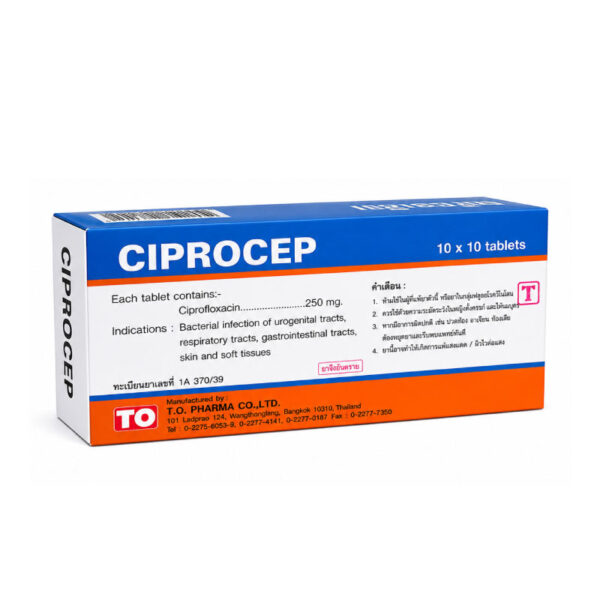
TO CIPROCEP (Ciprofloxacin) 250 mg 10×10 Tablets
Ciprofloxacin 250 mg เป็นยาปฏิชีวนะกลุ่ม fluoroquinolone ออกฤทธิ์ฆ่าเชื้อโดยยับยั้ง bacterial DNA gyrase และ topoisomerase IV ใช้รักษาการติดเชื้อแบคทีเรียที่ไวต่อยา โดยแนวทางปัจจุบันแนะนำให้ใช้เมื่อยาปฏิชีวนะที่เป็นทางเลือกแรกไม่เหมาะสม เนื่องจาก fluoroquinolones อาจทำให้เกิดอาการไม่พึงประสงค์ที่รุนแรงและยาวนานได้ ฐานข้อมูล อย. ไทยระบุ CIPROCEP เป็น Ciprofloxacin 250 mg ชนิด film-coated tablet โดยมี บริษัท ที.โอ.ฟาร์ม่า จำกัด เป็นผู้รับอนุญาต. (ข้อมูลยาแห่งชาติ)
การออกฤทธิ์
Ciprofloxacin เป็นยาปฏิชีวนะชนิด bactericidal ในกลุ่ม fluoroquinolone ออกฤทธิ์ยับยั้ง DNA gyrase (topoisomerase II) และ topoisomerase IV ซึ่งเป็นเอนไซม์สำคัญต่อการจำลอง การถอดรหัส การซ่อมแซม และการแยก DNA ของแบคทีเรีย
การยับยั้งเอนไซม์ดังกล่าวทำให้การเพิ่มจำนวนของเชื้อหยุดชะงักและนำไปสู่การตายของเซลล์แบคทีเรีย. (Medicines.org.uk)
ขอบเขตการทำลายเชื้อ
Ciprofloxacin มีฤทธิ์เด่นต่อแบคทีเรีย Gram-negative หลายชนิด เช่น Escherichia coli, Klebsiella spp., Enterobacter spp., Proteus spp., Citrobacter spp., Serratia spp., Haemophilus influenzae, Salmonella spp., Shigella spp. และ Pseudomonas aeruginosa ในกรณีที่เชื้อไวต่อยา
มีฤทธิ์ต่อ Gram-positive บางชนิด แต่ ไม่เหมาะเป็นยาหลักสำหรับ streptococcal infections รวมถึง Streptococcus pneumoniae เนื่องจากประสิทธิภาพไม่เพียงพอเมื่อเทียบกับทางเลือกอื่น. (Medicines.org.uk)
การรักษา gonorrhoea ด้วย Ciprofloxacin ควรทำเฉพาะเมื่อสามารถยืนยันหรือคาดได้อย่างน่าเชื่อถือว่า Neisseria gonorrhoeae ไวต่อ fluoroquinolone เนื่องจากมีปัญหาการดื้อยาสูง. (Medicines.org.uk)
เภสัชจลนศาสตร์
Ciprofloxacin ถูกดูดซึมอย่างรวดเร็วหลังรับประทาน โดยมี absolute oral bioavailability ประมาณ 70–80% และระดับยาในเลือดสูงสุดมักเกิดภายในประมาณ 1–2 ชั่วโมง
ยาจับกับ plasma protein ค่อนข้างต่ำประมาณ 20–30% และกระจายเข้าสู่เนื้อเยื่อได้กว้าง โดยเฉพาะทางเดินปัสสาวะ ปอด และต่อมลูกหมาก. (Medicines.org.uk)
ยาถูกกำจัดออกทางไตเป็นส่วนสำคัญ ดังนั้น renal impairment อาจทำให้ระดับยาเพิ่มขึ้นและจำเป็นต้องปรับขนาดหรือช่วงห่างของยา. (Medicines.org.uk)
ข้อห้ามใช้
ห้ามใช้ในผู้ที่แพ้ Ciprofloxacin, quinolones หรือส่วนประกอบของยา
ห้ามใช้ร่วมกับ tizanidine เนื่องจาก Ciprofloxacin ยับยั้ง CYP1A2 และทำให้ระดับ tizanidine เพิ่มสูงมาก ซึ่งอาจทำให้เกิด ความดันโลหิตต่ำและง่วงซึมอย่างรุนแรง. (Medicines.org.uk)
ควรหลีกเลี่ยงการใช้ในผู้ที่เคยมี serious adverse reaction จาก quinolone หรือ fluoroquinolone เว้นแต่ไม่มีทางเลือกอื่นที่เหมาะสมและได้รับการประเมิน benefit-risk อย่างรอบคอบ. (Medicines.org.uk)
ข้อความระวัง
Fluoroquinolones รวมถึง Ciprofloxacin อาจทำให้เกิดอาการไม่พึงประสงค์ที่ ยาวนาน ทำให้พิการ และอาจไม่กลับคืนเป็นปกติ โดยอาจเกี่ยวข้องกับระบบกล้ามเนื้อและกระดูก ระบบประสาท ระบบจิตเวช และประสาทสัมผัสหลายระบบพร้อมกัน. (Medicines.org.uk)
อาจเกิด tendinitis และ tendon rupture โดยเฉพาะ Achilles tendon ความเสี่ยงสูงขึ้นในผู้สูงอายุ ผู้มี renal impairment ผู้ปลูกถ่ายอวัยวะ และผู้ที่ใช้ systemic corticosteroids ร่วมด้วย ควรหยุดยาเมื่อเริ่มมีอาการปวดหรือบวมบริเวณเอ็น. (Medicines.org.uk)
อาจเกิด peripheral neuropathy เช่น ชา เสียวซ่า ปวดแสบปวดร้อน หรืออ่อนแรง หากเกิดอาการควรหยุดยาและรับการประเมิน
Ciprofloxacin อาจกระตุ้น seizure หรือลด seizure threshold และอาจเกิด psychiatric reactions ได้แม้หลังได้รับยาในช่วงแรก. (Medicines.org.uk)
ควรระวัง QT prolongation ในผู้ที่มี congenital long QT syndrome, hypokalaemia, hypomagnesaemia, bradycardia, heart failure หรือใช้ QT-prolonging medicines ร่วมกัน. (Medicines.org.uk)
อาจเกิดทั้ง hypoglycaemia และ hyperglycaemia โดยเฉพาะผู้ป่วยเบาหวานที่ใช้ insulin หรือยาลดน้ำตาลในเลือด. (Medicines.org.uk)
มีรายงานความสัมพันธ์กับ aortic aneurysm/dissection และ heart-valve regurgitation ในผู้ที่มีปัจจัยเสี่ยงบางกลุ่ม จึงควรพิจารณาทางเลือกอื่นเมื่อเหมาะสม. (Medicines.org.uk)
การใช้ยาในระยะตั้งครรภ์และให้นมบุตร
การตั้งครรภ์: ข้อมูลในหญิงตั้งครรภ์ที่มีอยู่ไม่ได้แสดงสัญญาณชัดเจนของ congenital malformation แต่เนื่องจากมีความกังวลจากข้อมูลสัตว์เกี่ยวกับ cartilage ของสิ่งมีชีวิตที่กำลังเจริญเติบโต SmPC ปัจจุบันแนะนำให้ หลีกเลี่ยง Ciprofloxacin ระหว่างตั้งครรภ์เป็นการป้องกันไว้ก่อน. (Medicines.org.uk)
การให้นมบุตร: Ciprofloxacin ถูกขับออกทางน้ำนมและตาม SmPC ที่ใช้อ้างอิง ไม่ควรใช้ระหว่างให้นมบุตร เนื่องจากความเสี่ยงต่อข้อและกระดูกอ่อนของทารกไม่สามารถตัดออกได้. (Medicines.org.uk)
อาการข้างเคียง
อาการที่พบได้บ่อย ได้แก่ คลื่นไส้และท้องเสีย. (Medicines.org.uk)
อาการอื่นที่อาจพบ ได้แก่ ปวดท้อง อาเจียน ปวดศีรษะ เวียนศีรษะ ผื่น และความผิดปกติของ liver enzymes
อาการสำคัญที่ต้องระวัง ได้แก่ tendinitis, tendon rupture, peripheral neuropathy, seizure, severe psychiatric reactions, QT prolongation, severe dysglycaemia, hepatotoxicity, anaphylaxis และ Clostridioides difficile-associated diarrhoea
ในผู้ป่วย myasthenia gravis Ciprofloxacin อาจทำให้อาการกล้ามเนื้ออ่อนแรงรุนแรงขึ้น. (Medicines.org.uk)
การได้รับยาเกินขนาด
ไม่มี specific antidote สำหรับ Ciprofloxacin overdose
การรักษาเป็นแบบ supportive และ symptomatic พร้อมดูแล hydration และติดตาม renal function รวมถึง ECG เพราะอาจเกิด QT prolongation. (Medicines.org.uk)
Ciprofloxacin ถูกกำจัดด้วย haemodialysis หรือ peritoneal dialysis ได้เพียงเล็กน้อย โดยข้อมูล SmPC ระบุว่าถูกกำจัดได้น้อยกว่า 10%. (Medicines.org.uk)
ปฏิกิริยาระหว่างยา
Tizanidine: ห้ามใช้ร่วมกัน เนื่องจากระดับ tizanidine เพิ่มขึ้นอย่างมากและเสี่ยง hypotension กับ sedation. (Medicines.org.uk)
Antacids, calcium, magnesium, aluminium, iron, zinc, sucralfate และ phosphate binders: ลดการดูดซึม Ciprofloxacin ควรรับประทาน Ciprofloxacin ประมาณ 1–2 ชั่วโมงก่อน หรืออย่างน้อย 4 ชั่วโมงหลัง ผลิตภัณฑ์เหล่านี้ตาม SmPC ที่ใช้อ้างอิง. (Medicines.org.uk)
นมหรือโยเกิร์ตที่รับประทานเดี่ยว ๆ และเครื่องดื่มเสริม calcium: อาจลดการดูดซึม จึงไม่ควรใช้รับประทานพร้อมยาโดยตรง แต่ calcium ที่เป็นส่วนหนึ่งของมื้ออาหารทั่วไปไม่มีผลสำคัญเช่นเดียวกัน. (Medicines.org.uk)
Theophylline: Ciprofloxacin อาจเพิ่มระดับ theophylline และทำให้เกิด toxicity จึงควรหลีกเลี่ยงหรือ monitor อย่างใกล้ชิด. (Medicines.org.uk)
Methotrexate: อาจเพิ่ม methotrexate exposure จึงไม่แนะนำให้ใช้ร่วมกันเมื่อหลีกเลี่ยงได้. (Medicines.org.uk)
Phenytoin: ระดับยาอาจเพิ่มหรือลด จึงควรติดตามระดับยาเมื่อจำเป็น
Cyclosporine: อาจทำให้ serum creatinine เพิ่มขึ้น
Warfarin และ vitamin K antagonists: อาจเพิ่ม anticoagulant effect จึงควรติดตาม INR
ยาที่ทำให้ QT prolongation เช่น class IA/III antiarrhythmics, tricyclic antidepressants, macrolides และ antipsychotics บางชนิด ควรใช้ร่วมกันด้วยความระมัดระวัง. (Medicines.org.uk)
ชื่อและความแรงของยา (Drug Name and Strength)
Ciprofloxacin 250 mg per film-coated tablet
สำนักงานคณะกรรมการอาหารและยาไทยระบุ CIPROCEP เป็น film-coated tablet มีสารสำคัญ ciprofloxacin hydrochloride เทียบเท่า Ciprofloxacin 250 mg ต่อเม็ด และผู้รับอนุญาตคือ บริษัท ที.โอ.ฟาร์ม่า จำกัด. (ข้อมูลยาแห่งชาติ)
ขนาดบรรจุตามสินค้าที่ระบุ:
10 แผง × 10 เม็ด รวม 100 เม็ด / กล่อง
ข้อบ่งใช้ (Indications)
Ciprofloxacin ใช้รักษาการติดเชื้อแบคทีเรียที่ไวต่อยาในผู้ใหญ่ เช่น การติดเชื้อทางเดินปัสสาวะ, pyelonephritis, bacterial prostatitis, การติดเชื้อทางเดินหายใจจาก Gram-negative bacteria, chronic sinusitis บางกรณี, chronic suppurative otitis media, การติดเชื้อระบบทางเดินอาหาร, intra-abdominal infection, การติดเชื้อผิวหนังและเนื้อเยื่ออ่อนจาก Gram-negative bacteria รวมถึง bone and joint infections. (Medicines.org.uk)
Current 2026 SmPC ระบุว่า เนื่องจากความเสี่ยงของ serious adverse reactions ที่อาจยาวนานและไม่กลับคืนเป็นปกติ Ciprofloxacin ควรใช้เมื่อยาปฏิชีวนะที่มักแนะนำเป็นอันดับแรกไม่เหมาะสม เช่น เชื้อดื้อยา มีข้อห้าม ใช้แล้วเกิด adverse effect หรือการรักษาแรกไม่ได้ผล. (Medicines.org.uk)
สำหรับ uncomplicated cystitis และโรคติดเชื้อบางชนิด ไม่ควรเลือก Ciprofloxacin เป็น routine first-line antibiotic หากยังมีทางเลือกที่เหมาะสมกว่า
ขนาดยาแนะนำ (Recommended Dosage)
ขนาดยาขึ้นกับ ตำแหน่งและความรุนแรงของการติดเชื้อ ความไวของเชื้อ renal function และปัจจัยของผู้ป่วย จึงไม่ควรใช้ regimen เดียวสำหรับทุกโรค. (Medicines.org.uk)
ตัวอย่างขนาดผู้ใหญ่จาก current SmPC ได้แก่:
Uncomplicated cystitis: 250–500 mg วันละ 2 ครั้ง โดยใน SmPC ที่ใช้อ้างอิงระบุระยะเวลาประมาณ 3 วัน ทั้งนี้ควรใช้ Ciprofloxacin เฉพาะเมื่อยาปฏิชีวนะที่แนะนำตามปกติไม่เหมาะสม
Complicated cystitis / uncomplicated pyelonephritis: 500 mg วันละ 2 ครั้ง
Complicated pyelonephritis: 500–750 mg วันละ 2 ครั้ง
Bacterial prostatitis: 500–750 mg วันละ 2 ครั้ง
Lower respiratory tract infection: 500–750 mg วันละ 2 ครั้ง
Skin and soft-tissue infection: 500–750 mg วันละ 2 ครั้ง
ขนาดและระยะเวลาจริงแตกต่างตาม diagnosis และความรุนแรง. (Medicines.org.uk)
ดังนั้น CIPROCEP 250 mg ไม่ได้หมายความว่าต้องรับประทานครั้งละ 1 เม็ด วันละ 2 ครั้งในทุกโรค
ใน renal impairment ตาม SmPC อ้างอิง:
Creatinine clearance 30–60 mL/min/1.73 m²: 250–500 mg ทุก 12 ชั่วโมง
Creatinine clearance ≤30 mL/min/1.73 m²: 250–500 mg ทุก 24 ชั่วโมง
ผู้ป่วย haemodialysis หรือ peritoneal dialysis: 250–500 mg ทุก 24 ชั่วโมง โดย haemodialysis ให้หลัง dialysis. (Medicines.org.uk)
สามารถรับประทานพร้อมหรือไม่พร้อมอาหารได้ กลืนยาพร้อมน้ำ และไม่ควรรับประทานพร้อมนมหรือโยเกิร์ตเพียงอย่างเดียวหรือเครื่องดื่มเสริม calcium. (Medicines.org.uk)
คำเตือนตามประกาศคำเตือนสาธารณะ (Warnings in Accordance with Public Safety Announcements)
Fluoroquinolones รวมถึง Ciprofloxacin อาจทำให้เกิด serious, prolonged, disabling และ potentially irreversible adverse reactions จึงควรใช้เมื่อยาปฏิชีวนะที่เป็นตัวเลือกมาตรฐานไม่เหมาะสม. (Medicines.org.uk)
หากมี ปวดหรือบวมบริเวณเอ็น ให้หยุดยาและหลีกเลี่ยงการใช้งานบริเวณดังกล่าว พร้อมรับการประเมินทางการแพทย์. (Medicines.org.uk)
หากมี ชา เสียวซ่า ปวดแสบปวดร้อน หรือกล้ามเนื้ออ่อนแรง ควรหยุดยาและได้รับการประเมิน peripheral neuropathy
หากมีอาการใจสั่น หน้ามืด เป็นลม หรือมีปัจจัยเสี่ยง QT prolongation ควรแจ้งแพทย์หรือเภสัชกร
ควรหลีกเลี่ยงการใช้ systemic corticosteroid ร่วมกับ fluoroquinolone หากเป็นไปได้ เนื่องจากเพิ่มความเสี่ยง tendon rupture. (Medicines.org.uk)
ไม่ควรใช้ Ciprofloxacin เพื่อรักษา ไข้หวัดหรือการติดเชื้อไวรัส และไม่ควรนำยาปฏิชีวนะที่เหลือจากครั้งก่อนมาใช้เอง เพื่อช่วยลดปัญหา antimicrobial resistance
ภาวะการเก็บรักษา (Storage Conditions)
ฐานข้อมูล อย. ไทยที่ตรวจสอบยืนยันชื่อ CIPROCEP, ความแรง 250 mg และรูปแบบ film-coated tablet แต่หน้าข้อมูลสาธารณะที่ตรวจสอบไม่ได้ระบุ storage condition เฉพาะของผลิตภัณฑ์ไทยอย่างชัดเจน. (ข้อมูลยาแห่งชาติ)
ดังนั้นควรยึด ฉลากและเอกสารกำกับ CIPROCEP 250 ของ T.O. Pharma ที่มากับผลิตภัณฑ์จริงเป็นหลัก
เพื่อเป็นข้อมูลอ้างอิง Ciprofloxacin 250 mg film-coated tablets ใน current UK SmPC ระบุว่า ไม่ต้องมีเงื่อนไขการเก็บรักษาพิเศษ แต่ไม่ควรใช้ข้อมูลนี้แทนข้อกำหนดเฉพาะของ CIPROCEP หากฉลากไทยระบุแตกต่างกัน. (Medicines.org.uk)
แหล่งข้อมูลอ้างอิง
สำนักงานคณะกรรมการอาหารและยา — CIPROCEP 250
emc — Ciprofloxacin 250 mg Film-coated Tablets SmPC
emc — Ciprofloxacin 250 mg Film-coated Tablets SmPC, Aurobindo
หมายเหตุสำคัญ: ข้อมูลนี้จัดทำขึ้นเพื่อให้ความรู้เบื้องต้นเกี่ยวกับยาเท่านั้น ไม่สามารถใช้แทนการวินิจฉัย การรักษา หรือคำแนะนำจากบุคลากรทางการแพทย์ได้ การเลือกใช้ยา ขนาดยา และระยะเวลาการรักษาอาจแตกต่างกันในแต่ละบุคคล โปรดปรึกษาแพทย์หรือเภสัชกรก่อนใช้ยาทุกครั้ง และไม่ควรปรับขนาดยา หยุดยา หรือใช้ยาร่วมกับยาอื่นด้วยตนเอง เพื่อความปลอดภัยในการใช้ยา
TO CIPROCEP (Ciprofloxacin) 250 mg 10×10 Tablets
Ciprofloxacin 250 mg is a fluoroquinolone antibacterial medicine that inhibits bacterial DNA gyrase and topoisomerase IV. It is used for susceptible bacterial infections when commonly recommended first-line antibiotics are inappropriate because fluoroquinolones may cause serious, prolonged, disabling, and potentially irreversible adverse reactions. The Thai FDA identifies CIPROCEP as a 250 mg film-coated tablet containing ciprofloxacin hydrochloride, licensed to T.O. Pharma Co., Ltd. (ข้อมูลยาแห่งชาติ)
Mechanism of Action
Ciprofloxacin is a bactericidal fluoroquinolone.
It inhibits bacterial DNA gyrase (topoisomerase II) and topoisomerase IV, thereby disrupting DNA replication, transcription, repair, and chromosome segregation.
This interference with bacterial DNA processes ultimately results in bacterial cell death. (Medicines.org.uk)
Antimicrobial Spectrum
Ciprofloxacin has strong activity against many susceptible Gram-negative bacteria, including E. coli, Klebsiella, Enterobacter, Proteus, Citrobacter, Serratia, Haemophilus, Salmonella, Shigella, and selected Pseudomonas aeruginosa isolates.
Activity against Gram-positive organisms is less reliable. Ciprofloxacin is not recommended for streptococcal infections, including Streptococcus pneumoniae, because of inadequate efficacy. (Medicines.org.uk)
Local antimicrobial susceptibility and resistance patterns should be considered before treatment.
Pharmacokinetics
Ciprofloxacin is rapidly absorbed after oral administration, reaching peak serum concentrations in approximately 1–2 hours.
Absolute oral bioavailability is approximately 70–80%.
Protein binding is relatively low at approximately 20–30%, and the drug distributes widely into tissues, including the respiratory and genitourinary tracts. (Medicines.org.uk)
Renal elimination is clinically important, so dose adjustment is required when kidney function is significantly reduced. (Medicines.org.uk)
Contraindications
Ciprofloxacin is contraindicated in patients with hypersensitivity to Ciprofloxacin, other quinolones, or formulation excipients.
Concomitant use with tizanidine is contraindicated because Ciprofloxacin markedly increases tizanidine exposure, with potentially severe hypotension and sedation. (Medicines.org.uk)
Patients with a previous serious adverse reaction to quinolones or fluoroquinolones should generally avoid Ciprofloxacin unless no appropriate alternative treatment exists. (Medicines.org.uk)
Precautions
Ciprofloxacin may cause prolonged, disabling, and potentially irreversible adverse reactions, including musculoskeletal, neurological, psychiatric, and sensory effects. (Medicines.org.uk)
Tendinitis and tendon rupture may occur during treatment or even months after discontinuation. Risk is increased in older adults, renal impairment, transplant recipients, and patients receiving corticosteroids. (Medicines.org.uk)
Peripheral neuropathy may present with burning pain, numbness, tingling, or weakness.
Ciprofloxacin may lower the seizure threshold and can cause serious CNS or psychiatric effects.
Caution is required in patients at risk of QT prolongation and in those receiving other QT-prolonging medicines. (Medicines.org.uk)
Both hypoglycaemia and hyperglycaemia have been reported, particularly in patients with diabetes receiving insulin or oral glucose-lowering therapy. (Medicines.org.uk)
Use During Pregnancy and Breastfeeding
Pregnancy: Available human data have not demonstrated a clear malformation signal; however, because quinolone exposure has affected immature cartilage in animal studies, current SmPC guidance recommends avoiding Ciprofloxacin during pregnancy as a precaution. (Medicines.org.uk)
Breastfeeding: Ciprofloxacin is excreted into breast milk and should not be used during breastfeeding under the referenced SmPC because potential articular risk to the infant cannot be excluded. (Medicines.org.uk)
Adverse Effects
The most commonly reported adverse reactions are nausea and diarrhoea. (Medicines.org.uk)
Other adverse reactions may include vomiting, abdominal discomfort, headache, dizziness, rash, and liver-enzyme abnormalities.
Clinically important adverse effects include tendinitis/tendon rupture, peripheral neuropathy, seizures, psychiatric reactions, QT prolongation, severe dysglycaemia, hepatotoxicity, hypersensitivity, and C. difficile-associated diarrhoea.
Overdose
There is no specific antidote for Ciprofloxacin overdose.
Treatment is supportive and symptomatic, with adequate hydration, renal monitoring, and ECG monitoring where appropriate because QT prolongation may occur. (Medicines.org.uk)
Less than 10% of Ciprofloxacin is removed by haemodialysis or peritoneal dialysis. (Medicines.org.uk)
Drug Interactions
Tizanidine: Contraindicated. (Medicines.org.uk)
Antacids, calcium, magnesium, aluminium, iron, zinc, sucralfate, and phosphate binders: These may substantially reduce Ciprofloxacin absorption. The referenced SmPC recommends administration 1–2 hours before or at least 4 hours after these products. (Medicines.org.uk)
Dairy products or calcium-fortified drinks taken alone: May reduce absorption. Calcium consumed as part of a normal meal has less clinically significant impact. (Medicines.org.uk)
Theophylline: Ciprofloxacin may markedly increase theophylline levels and toxicity.
Methotrexate: Exposure may increase; concomitant use is not recommended where avoidable.
Phenytoin: Concentrations may increase or decrease.
Cyclosporine: Serum creatinine may rise.
Vitamin K antagonists such as warfarin: Anticoagulant effects may be enhanced.
Medicines that prolong the QT interval require additional caution. (Medicines.org.uk)
Drug Name and Strength
Ciprofloxacin 250 mg per film-coated tablet
The Thai FDA identifies CIPROCEP as a 250 mg film-coated tablet containing ciprofloxacin hydrochloride equivalent to Ciprofloxacin 250 mg, licensed to T.O. Pharma Co., Ltd. (ข้อมูลยาแห่งชาติ)
Specified pack size:
10 blisters × 10 tablets = 100 tablets / box
Indications
Ciprofloxacin may be used for susceptible infections including selected urinary tract infections, acute pyelonephritis, bacterial prostatitis, Gram-negative respiratory infections, chronic suppurative otitis media, selected sinus infections, gastrointestinal infections, intra-abdominal infections, Gram-negative skin and soft-tissue infections, and bone and joint infections. (Medicines.org.uk)
Current 2026 SmPC guidance states that Ciprofloxacin should generally be prescribed only when commonly recommended first-line antibiotics are inappropriate, such as documented resistance, contraindication, intolerance, or treatment failure. (Medicines.org.uk)
Recommended Dosage
Dosage depends on the site and severity of infection, bacterial susceptibility, renal function, and individual patient factors. (Medicines.org.uk)
Examples from the referenced current SmPC include:
Uncomplicated cystitis: 250–500 mg twice daily, generally for 3 days when Ciprofloxacin is clinically appropriate.
Complicated cystitis / uncomplicated pyelonephritis: 500 mg twice daily.
Complicated pyelonephritis: 500–750 mg twice daily.
Bacterial prostatitis: 500–750 mg twice daily.
Lower respiratory tract infections: 500–750 mg twice daily.
Skin and soft-tissue infections: 500–750 mg twice daily. (Medicines.org.uk)
Therefore, CIPROCEP 250 mg should not automatically be interpreted as “one tablet twice daily” for every infection.
For renal impairment, the referenced SmPC recommends:
CrCl 30–60 mL/min/1.73 m²: 250–500 mg every 12 hours.
CrCl ≤30 mL/min/1.73 m²: 250–500 mg every 24 hours.
Haemodialysis or peritoneal dialysis: 250–500 mg every 24 hours; in haemodialysis, administer after dialysis. (Medicines.org.uk)
The tablets may be taken with or without food and should be swallowed with fluid. Avoid taking them directly with milk, yoghurt, or calcium-fortified beverages. (Medicines.org.uk)
Warnings in Accordance with Public Safety Announcements
Fluoroquinolones, including Ciprofloxacin, may cause serious, prolonged, disabling, and potentially irreversible adverse reactions and should be reserved for situations where commonly recommended antibiotics are inappropriate. (Medicines.org.uk)
Stop treatment and seek medical assessment for tendon pain or swelling. (Medicines.org.uk)
Stop treatment and seek assessment for numbness, tingling, burning pain, or weakness suggestive of peripheral neuropathy.
Avoid concomitant systemic corticosteroids where possible because of the increased risk of tendon rupture. (Medicines.org.uk)
Ciprofloxacin should not be used for viral infections such as the common cold and should not be self-started from leftover antibiotics.
Storage Conditions
The Thai FDA confirms the identity, strength, and film-coated tablet dosage form of CIPROCEP 250, but the public Thai record retrieved does not clearly state product-specific storage conditions. (ข้อมูลยาแห่งชาติ)
The Thai marketed CIPROCEP 250 package label and T.O. Pharma package insert should therefore take precedence.
For reference only, a current UK Ciprofloxacin 250 mg SmPC states that the product does not require special storage conditions. This should not automatically be treated as CIPROCEP-specific if the Thai label differs. (Medicines.org.uk)
References
Thai FDA — CIPROCEP 250
emc — Ciprofloxacin 250 mg Film-coated Tablets SmPC
emc — Ciprofloxacin 250 mg Film-coated Tablets SmPC, Aurobindo
Important Notice: This information is provided for general educational purposes only and is not intended to replace professional medical diagnosis, treatment, or advice. The appropriate medicine, dosage, and duration of treatment may vary from person to person. Always consult a doctor or pharmacist before using any medication. Do not change the dose, stop treatment, or combine medicines on your own without professional advice.