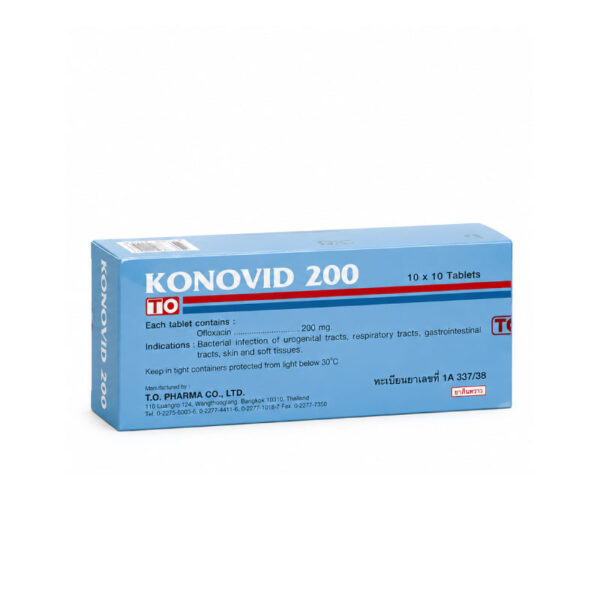
TO KONOVID (Ofloxacin) 200 mg 10×10 Tablets
Ofloxacin 200 mg เป็นยาปฏิชีวนะกลุ่ม fluoroquinolone ออกฤทธิ์ยับยั้ง DNA gyrase และ topoisomerase IV ของแบคทีเรีย ใช้รักษาการติดเชื้อแบคทีเรียที่ไวต่อยา โดยควรเลือกใช้เมื่อยาปฏิชีวนะที่แนะนำเป็นอันดับแรกไม่เหมาะสม เนื่องจาก fluoroquinolones อาจก่ออาการไม่พึงประสงค์รุนแรงและยาวนานได้ ฐานข้อมูล อย. ไทยระบุ KONOVID 200 เป็น Ofloxacin 200 mg ชนิด film-coated tablet ของ บริษัท ที.โอ. ฟาร์ม่า จำกัด. (ข้อมูลยาแห่งชาติ)
การออกฤทธิ์
Ofloxacin เป็นยาปฏิชีวนะกลุ่ม fluoroquinolone ที่มีฤทธิ์ bactericidal โดยยับยั้งเอนไซม์ DNA gyrase (topoisomerase II) และ topoisomerase IV ซึ่งจำเป็นต่อการจำลอง การถอดรหัส การซ่อมแซม และการแยกสาย DNA ของแบคทีเรีย
การยับยั้งเอนไซม์เหล่านี้ทำให้การจำลอง DNA หยุดชะงักและนำไปสู่การตายของเซลล์แบคทีเรีย โดยประสิทธิผลสัมพันธ์กับอัตราส่วน AUC/MIC และ Cmax/MIC. (Medicines.org.uk)
ขอบเขตการทำลายเชื้อ
Ofloxacin มีฤทธิ์ต่อแบคทีเรีย Gram-negative และ Gram-positive หลายชนิด แต่ความไวของเชื้อขึ้นกับพื้นที่และการดื้อยาในช่วงเวลานั้น
เชื้อที่อาจไวต่อยา ได้แก่ Escherichia coli, Klebsiella spp., Enterobacter spp., Citrobacter spp., Proteus spp., Haemophilus influenzae, Neisseria gonorrhoeae ที่ยืนยันว่าไวต่อยา, methicillin-susceptible Staphylococcus aureus, Salmonella, Shigella, Chlamydia และ Legionella pneumophila. (Medicines.org.uk)
เชื้อบางชนิดมีความไวไม่แน่นอนหรือมีอัตราดื้อยาสูง เช่น Pseudomonas aeruginosa, Streptococcus pneumoniae, Enterococcus spp. และ Acinetobacter spp.
Ofloxacin ไม่เหมาะสำหรับรักษาเชื้อบางชนิด เช่น Clostridioides difficile, Treponema pallidum และ Bacteroides spp. และไม่ควรใช้รักษา gonorrhoea แบบ empirical หากยังไม่ได้ยืนยันว่าเชื้อ N. gonorrhoeae ไวต่อ Ofloxacin เนื่องจากปัญหาการดื้อยา. (Medicines.org.uk)
เภสัชจลนศาสตร์
Ofloxacin ถูกดูดซึมจากทางเดินอาหารได้อย่างรวดเร็วและเกือบสมบูรณ์ หลังรับประทาน 200 mg ระดับยาในพลาสมาสูงสุดเฉลี่ยประมาณ 2.6 µg/mL และมักถึงระดับสูงสุดภายในประมาณ 1 ชั่วโมง. (Medicines.org.uk)
ยาจับกับ plasma protein ประมาณ 25% และมี apparent volume of distribution ประมาณ 120 ลิตร จึงกระจายเข้าสู่เนื้อเยื่อและของเหลวในร่างกายได้ดี
Ofloxacin ถูก metabolized ค่อนข้างน้อย โดย biotransformation ต่ำกว่า 5% และถูกขับออกทางไตเป็นหลัก ประมาณ 80–90% ของขนาดยาถูกพบในปัสสาวะในรูป unchanged drug
Plasma elimination half-life อยู่ประมาณ 5.7–7 ชั่วโมง และจะยาวนานขึ้นเมื่อไตทำงานลดลง จึงจำเป็นต้องปรับขนาดใน renal impairment. (Medicines.org.uk)
ข้อห้ามใช้
ห้ามใช้ในผู้ที่แพ้ Ofloxacin, fluoroquinolones หรือส่วนประกอบของยา
ตาม SmPC ที่ใช้อ้างอิง ห้ามใช้ในผู้ที่มี ประวัติโรคลมชักหรือมี seizure threshold ต่ำจากความผิดปกติของระบบประสาทส่วนกลางบางชนิด
ห้ามใช้ในผู้ที่มี ประวัติ tendon disorder ที่สัมพันธ์กับการใช้ fluoroquinolone
ห้ามใช้ใน เด็กหรือวัยรุ่นที่ยังอยู่ในช่วงเจริญเติบโต
ห้ามใช้ระหว่าง ตั้งครรภ์และให้นมบุตร ตาม European/UK product information ที่ใช้อ้างอิง. (Medicines.org.uk)
ผู้ที่เคยเกิด serious adverse reaction จาก quinolone หรือ fluoroquinolone ควรหลีกเลี่ยงการใช้ซ้ำ เว้นแต่ไม่มีทางเลือกอื่นและได้รับการประเมิน benefit-risk อย่างรอบคอบ. (Medicines.org.uk)
ข้อความระวัง
Fluoroquinolones รวมถึง Ofloxacin อาจทำให้เกิดอาการไม่พึงประสงค์ที่ รุนแรง ยาวนาน ทำให้พิการ และบางกรณีอาจไม่กลับเป็นปกติ โดยสามารถเกิดกับหลายระบบพร้อมกันได้ แม้ในผู้ที่ไม่มีปัจจัยเสี่ยงเด่นชัด. (Medicines.org.uk)
ควรหยุดยาและพบแพทย์เมื่อมีอาการ ปวดหรือบวมบริเวณเอ็น เนื่องจากอาจเกิด tendinitis หรือ tendon rupture โดยเฉพาะ Achilles tendon ความเสี่ยงสูงขึ้นในผู้สูงอายุ ผู้มี renal impairment ผู้ปลูกถ่ายอวัยวะ และผู้ใช้ corticosteroids
อาจเกิด peripheral neuropathy เช่น ปวดแสบปวดร้อน ชา เสียวซ่า หรืออ่อนแรง หากมีอาการควรหยุดยาเพื่อป้องกันความเสียหายที่อาจถาวร
อาจเกิดอาการทางระบบประสาทส่วนกลาง เช่น เวียนศีรษะ สับสน กระสับกระส่าย hallucinations, depression, psychotic reactions หรือ seizure
ต้องระวัง QT interval prolongation โดยเฉพาะผู้สูงอายุ ผู้มี electrolyte imbalance, congenital long QT syndrome, bradycardia หรือใช้ยาที่ทำให้ QT prolongation ร่วมกัน. (Medicines.org.uk)
Fluoroquinolones มีรายงานความสัมพันธ์กับ aortic aneurysm/dissection และ heart valve regurgitation โดยเฉพาะในผู้ที่มีปัจจัยเสี่ยง ควรประเมินอย่างระมัดระวังในผู้ป่วยกลุ่มดังกล่าว. (Medicines.org.uk)
ควรระวัง dysglycaemia โดยเฉพาะผู้ป่วยเบาหวานที่ใช้ insulin หรือยาลดน้ำตาลในเลือด
การใช้ยาในระยะตั้งครรภ์และให้นมบุตร
การตั้งครรภ์: Ofloxacin มีข้อห้ามใช้ระหว่างตั้งครรภ์ตาม SmPC ที่ใช้อ้างอิง เนื่องจากข้อมูลสัตว์ทดลองของ quinolones ทำให้มีความกังวลเรื่องผลต่อ cartilage ของสิ่งมีชีวิตที่กำลังเจริญเติบโต แม้ข้อมูลมนุษย์จะไม่เพียงพอที่จะระบุความเสี่ยงได้อย่างแม่นยำ. (Medicines.org.uk)
การให้นมบุตร: Ofloxacin ผ่านเข้าสู่น้ำนมได้ จึงมีข้อห้ามใช้ระหว่างให้นมบุตรตาม SmPC ที่ใช้อ้างอิง. (Medicines.org.uk)
อาการข้างเคียง
อาการที่อาจพบ ได้แก่ คลื่นไส้ อาเจียน ปวดท้อง ท้องเสีย ปวดศีรษะ เวียนศีรษะ นอนไม่หลับ และผื่น
อาการสำคัญที่ต้องระวัง ได้แก่ anaphylaxis, severe skin reactions, tendinitis/tendon rupture, peripheral neuropathy, seizure, psychiatric reactions, QT prolongation, severe hypoglycaemia หรือ hyperglycaemia, hepatotoxicity และ Clostridioides difficile-associated diarrhoea
หากมีท้องเสียรุนแรงหรือถ่ายเป็นเลือดระหว่างหรือหลังใช้ยา ไม่ควรใช้ยาหยุดถ่ายเองจนกว่าจะได้รับการประเมิน เพราะอาจเป็น antibiotic-associated colitis. (Medicines.org.uk)
การได้รับยาเกินขนาด
อาการจาก overdose อาจเกี่ยวข้องกับระบบประสาท เช่น สับสน เวียนศีรษะ ชัก หรือ altered consciousness รวมถึงอาการทางระบบทางเดินอาหาร
ควรให้การรักษาแบบ supportive และ symptomatic และควรติดตาม ECG เนื่องจากมีความเสี่ยง QT prolongation
ไม่มี specific antidote
การทำ haemodialysis สามารถกำจัด Ofloxacin ออกได้เพียงบางส่วน ขณะที่ peritoneal dialysis และ CAPD ไม่มีประสิทธิภาพในการกำจัดยาอย่างมีนัยสำคัญ. (Medicines.org.uk)
ปฏิกิริยาระหว่างยา
Antacids และผลิตภัณฑ์ที่มี aluminium, magnesium, iron หรือ zinc รวมถึง sucralfate: สามารถลดการดูดซึม Ofloxacin จึงควรแยกเวลารับประทานอย่างน้อย 2 ชั่วโมง. (Medicines.org.uk)
ยาที่ทำให้ QT prolongation: เช่น class IA/III antiarrhythmics, tricyclic antidepressants, macrolides และ antipsychotics บางชนิด อาจเพิ่มความเสี่ยงหัวใจเต้นผิดจังหวะ
Warfarin และ vitamin K antagonists: อาจเพิ่ม anticoagulant effect จึงควรติดตาม coagulation parameters เช่น INR
ยาลดน้ำตาลในเลือด/insulin: อาจเพิ่มความเสี่ยง dysglycaemia ควรติดตาม blood glucose
NSAIDs หรือยาที่ลด seizure threshold: อาจเพิ่มความเสี่ยง CNS stimulation หรือ seizure ในผู้ป่วยบางราย
ควรหลีกเลี่ยงการใช้ corticosteroids ร่วมกับ fluoroquinolones หากเป็นไปได้ เนื่องจากเพิ่มความเสี่ยง tendinitis และ tendon rupture. (Medicines.org.uk)
ชื่อและความแรงของยา (Drug Name and Strength)
Ofloxacin 200 mg per film-coated tablet
ฐานข้อมูลสำนักงานคณะกรรมการอาหารและยาไทยระบุ KONOVID 200 เป็น Ofloxacin 200 mg film-coated tablet โดยผู้รับอนุญาตคือ บริษัท ที.โอ. ฟาร์ม่า จำกัด. (ข้อมูลยาแห่งชาติ)
กรมวิทยาศาสตร์การแพทย์ยังมี KONOVID 200 อยู่ใน Green Book ของ Ofloxacin tablets โดยระบุผู้ผลิต T.O. Chemicals/T.O. Pharma ในข้อมูลผลิตภัณฑ์ที่เกี่ยวข้อง. (BDN)
ขนาดบรรจุตามสินค้าที่ผู้ใช้ระบุคือ:
10 แผง × 10 เม็ด รวม 100 เม็ด / กล่อง
ข้อบ่งใช้ (Indications)
Ofloxacin ใช้รักษาการติดเชื้อแบคทีเรียที่ยืนยันหรือคาดว่ามีความไวต่อยา โดย แนวทางปัจจุบันจำกัดการใช้ fluoroquinolones ให้เลือกใช้เมื่อยาปฏิชีวนะที่แนะนำเป็นอันดับแรกไม่เหมาะสม เช่น เชื้อดื้อยา มีข้อห้ามต่อยาทางเลือก เกิด adverse effect จนต้องหยุดยา หรือการรักษาอันดับแรกไม่ได้ผล. (Medicines.org.uk)
ข้อบ่งใช้ในผู้ใหญ่ตาม current SmPC ประกอบด้วย acute pyelonephritis และ complicated urinary tract infection, uncomplicated cystitis, non-gonococcal urethritis/cervicitis, gonococcal urethritis/cervicitis ที่ยืนยันเชื้อไวต่อยา, acute exacerbation of COPD/chronic bronchitis และ community-acquired pneumonia เมื่อ Ofloxacin เป็นทางเลือกที่เหมาะสม. (Medicines.org.uk)
สำหรับ gonorrhoea ไม่ควรใช้แบบ empirical treatment หากยังไม่ได้ยืนยันความไวของเชื้อ เพราะ N. gonorrhoeae มีปัญหาการดื้อ fluoroquinolone สูงในหลายพื้นที่. (Medicines.org.uk)
ควรพิจารณา antimicrobial susceptibility, local resistance pattern และแนวทางการใช้ยาปฏิชีวนะของประเทศไทย ก่อนเลือกใช้
ขนาดยาแนะนำ (Recommended Dosage)
ขนาดยาขึ้นกับชนิด ความรุนแรง และตำแหน่งของการติดเชื้อ รวมถึง renal function ของผู้ป่วย
ช่วงขนาดในผู้ใหญ่ตาม SmPC อ้างอิงคือ:
Ofloxacin 200–800 mg ต่อวัน
ขนาดรวมไม่เกิน 400 mg/day อาจให้วันละครั้งได้ โดยมักให้ในช่วงเช้า ส่วนขนาดมากกว่า 400 mg/day ควรแบ่งเป็น 2 ครั้งในช่วงเวลาห่างกันใกล้เคียงกัน. (Medicines.org.uk)
ตัวอย่างขนาดตามข้อบ่งใช้ใน SmPC ได้แก่ uncomplicated cystitis 200–400 mg/day, acute pyelonephritis หรือ complicated UTI เริ่มประมาณ 400 mg/day และอาจเพิ่มถึง 400 mg วันละ 2 ครั้งในกรณีที่จำเป็น รวมถึง respiratory infection บางชนิดที่อาจใช้ 400 mg/day และเพิ่มได้ตามความรุนแรง. (Medicines.org.uk)
ดังนั้น KONOVID 200 mg เป็นความแรงสำหรับประกอบ regimen ตามชนิดของการติดเชื้อ ไม่ควรสรุปว่า “ครั้งละ 1 เม็ด วันละ 2 ครั้ง” ใช้ได้กับทุกโรค
ใน renal impairment ต้องลดขนาดหรือปรับช่วงห่างของยา เนื่องจาก Ofloxacin ถูกกำจัดทางไตเป็นหลัก. (Medicines.org.uk)
สามารถรับประทานก่อนหรือพร้อมอาหารได้ ควรกลืนพร้อมน้ำ และควรแยกจาก antacids, sucralfate, iron, magnesium, aluminium หรือ zinc อย่างน้อย 2 ชั่วโมง
ควรใช้ยาตามระยะเวลาที่แพทย์กำหนด ไม่หยุดยาเองเมื่ออาการดีขึ้น และไม่ควรใช้รักษาการติดเชื้อไวรัส
คำเตือนตามประกาศคำเตือนสาธารณะ (Warnings in Accordance with Public Safety Announcements)
Fluoroquinolones รวมถึง Ofloxacin ควรใช้เมื่อ ยาปฏิชีวนะทางเลือกที่แนะนำเป็นอันดับแรกไม่เหมาะสม เพราะอาจทำให้เกิด adverse reactions ที่รุนแรง ยาวนาน ทำให้พิการ และบางครั้งอาจไม่กลับคืนเป็นปกติ. (Medicines.org.uk)
หากมี ปวดหรือบวมบริเวณเอ็น ให้หยุดยา พักบริเวณดังกล่าว และรับการประเมินทันที เนื่องจาก tendon rupture อาจเกิดขึ้นระหว่างรักษาหรือภายหลังหยุดยา
หากมี ชา เสียวซ่า ปวดแสบปวดร้อน หรือกล้ามเนื้ออ่อนแรง ควรหยุดยาและรับการประเมิน peripheral neuropathy
หากมีใจสั่น หน้ามืด เป็นลม หรือมีโรคหัวใจ/ใช้ยาที่ทำให้ QT prolongation ควรแจ้งแพทย์หรือเภสัชกร
หากมีอาการแพ้รุนแรง หายใจลำบาก หน้าหรือคอบวม หรือผื่นรุนแรง ควรหยุดยาและรับการรักษาฉุกเฉิน
ไม่ควรซื้อ Ofloxacin ใช้เองสำหรับ เจ็บคอ ไข้หวัด หรือการติดเชื้อไวรัส และไม่ควรใช้ยาที่เหลือจากครั้งก่อน เนื่องจากเพิ่มความเสี่ยง antimicrobial resistance
ภาวะการเก็บรักษา (Storage Conditions)
ฐานข้อมูล อย. ไทยที่ตรวจสอบยืนยันชื่อ KONOVID 200, ตัวยา Ofloxacin 200 mg และรูปแบบ film-coated tablet แต่ข้อมูลสาธารณะที่ค้นพบไม่ได้แสดง storage condition เฉพาะของผลิตภัณฑ์ KONOVID 200 ในประเทศไทย อย่างชัดเจน. (ข้อมูลยาแห่งชาติ)
ดังนั้นควรยึด ฉลากและเอกสารกำกับ KONOVID 200 ของ T.O. Pharma ที่มากับผลิตภัณฑ์จริงเป็นหลัก
เพื่อข้อมูลอ้างอิง Ofloxacin 200 mg Tablets ของ Viatris ในสหราชอาณาจักรระบุว่า ไม่จำเป็นต้องมีเงื่อนไขการเก็บรักษาพิเศษ แต่ข้อมูลดังกล่าวไม่ควรใช้แทนข้อกำหนดเฉพาะของ KONOVID หากฉลากไทยระบุแตกต่างกัน. (Medicines.org.uk)
แหล่งข้อมูลอ้างอิง
สำนักงานคณะกรรมการอาหารและยา — KONOVID 200
กรมวิทยาศาสตร์การแพทย์ — Green Book
Viatris / emc — Ofloxacin 200 mg Tablets SmPC
หมายเหตุสำคัญ: ข้อมูลนี้จัดทำขึ้นเพื่อให้ความรู้เบื้องต้นเกี่ยวกับยาเท่านั้น ไม่สามารถใช้แทนการวินิจฉัย การรักษา หรือคำแนะนำจากบุคลากรทางการแพทย์ได้ การเลือกใช้ยา ขนาดยา และระยะเวลาการรักษาอาจแตกต่างกันในแต่ละบุคคล โปรดปรึกษาแพทย์หรือเภสัชกรก่อนใช้ยาทุกครั้ง และไม่ควรปรับขนาดยา หยุดยา หรือใช้ยาร่วมกับยาอื่นด้วยตนเอง เพื่อความปลอดภัยในการใช้ยา
TO KONOVID (Ofloxacin) 200 mg 10×10 Tablets
Ofloxacin 200 mg is a fluoroquinolone antibacterial agent that inhibits bacterial DNA gyrase and topoisomerase IV. It is used for susceptible bacterial infections when commonly recommended first-line antibiotics are inappropriate because fluoroquinolones can cause serious, prolonged, disabling, and potentially irreversible adverse reactions. The Thai FDA identifies KONOVID 200 as an Ofloxacin 200 mg film-coated tablet licensed to T.O. Pharma Co., Ltd. (ข้อมูลยาแห่งชาติ)
Mechanism of Action
Ofloxacin is a bactericidal fluoroquinolone.
It inhibits bacterial DNA gyrase (topoisomerase II) and topoisomerase IV, enzymes essential for DNA replication, transcription, repair, and chromosome segregation.
Its antibacterial activity is concentration dependent, with AUC/MIC and Cmax/MIC serving as important pharmacodynamic predictors of efficacy. (Medicines.org.uk)
Antimicrobial Spectrum
Ofloxacin has activity against a range of Gram-negative and Gram-positive organisms, although susceptibility varies geographically and over time.
Potentially susceptible organisms include Escherichia coli, Klebsiella spp., Enterobacter spp., Citrobacter spp., Proteus spp., Haemophilus influenzae, susceptible Neisseria gonorrhoeae, methicillin-susceptible Staphylococcus aureus, Salmonella, Shigella, Chlamydia, and Legionella pneumophila. (Medicines.org.uk)
Susceptibility is less predictable for organisms such as Pseudomonas aeruginosa, Streptococcus pneumoniae, Enterococcus spp., and Acinetobacter spp.
Organisms considered resistant or poorly covered include Clostridioides difficile, Treponema pallidum, and Bacteroides spp. (Medicines.org.uk)
Because of widespread fluoroquinolone resistance, gonorrhoea should not be treated empirically with Ofloxacin unless N. gonorrhoeae susceptibility has been confirmed.
Pharmacokinetics
Ofloxacin is rapidly and almost completely absorbed after oral administration.
Following a single 200 mg oral dose, mean peak plasma concentration is approximately 2.6 µg/mL, generally reached within about 1 hour. (Medicines.org.uk)
Plasma protein binding is approximately 25%, and the apparent volume of distribution is about 120 litres.
Metabolism is minimal, accounting for less than 5% of the dose.
Elimination is predominantly renal, with approximately 80–90% recovered unchanged in urine.
The plasma elimination half-life is approximately 5.7–7 hours and is prolonged in renal impairment. (Medicines.org.uk)
Contraindications
Ofloxacin is contraindicated in patients with hypersensitivity to Ofloxacin, other quinolones, or formulation excipients.
The referenced SmPC contraindicates use in patients with epilepsy or certain CNS disorders associated with a reduced seizure threshold.
It is contraindicated in patients with a history of fluoroquinolone-associated tendon disorders.
It is contraindicated in children and growing adolescents.
The referenced European/UK product information also contraindicates use during pregnancy and breastfeeding. (Medicines.org.uk)
Use should generally be avoided in patients who have previously experienced a serious adverse reaction to a quinolone or fluoroquinolone unless no suitable alternative exists. (Medicines.org.uk)
Precautions
Fluoroquinolones may cause prolonged, disabling, and potentially irreversible adverse reactions affecting multiple organ systems, sometimes after only limited exposure. (Medicines.org.uk)
Tendinitis and tendon rupture may occur, particularly involving the Achilles tendon. Risk is increased in older adults, renal impairment, organ-transplant recipients, and patients receiving corticosteroids.
Peripheral neuropathy may present with burning pain, tingling, numbness, or weakness and may become persistent.
CNS and psychiatric effects may include dizziness, confusion, agitation, hallucinations, depression, psychosis, or seizures.
Ofloxacin may prolong the QT interval; caution is required in patients with congenital long QT syndrome, electrolyte abnormalities, bradycardia, cardiac disease, or concomitant QT-prolonging medicines. (Medicines.org.uk)
Fluoroquinolone exposure has also been associated with aortic aneurysm/dissection and cardiac-valve regurgitation, particularly in susceptible patients. (Medicines.org.uk)
Use During Pregnancy and Breastfeeding
Pregnancy: Ofloxacin is contraindicated during pregnancy under the referenced SmPC because quinolone-associated effects on developing cartilage cannot be excluded. (Medicines.org.uk)
Breastfeeding: Ofloxacin passes into breast milk and is contraindicated during breastfeeding under the referenced product information. (Medicines.org.uk)
Adverse Effects
Adverse effects may include nausea, vomiting, abdominal discomfort, diarrhoea, headache, dizziness, insomnia, and rash.
Clinically important reactions include anaphylaxis, severe cutaneous reactions, tendinitis/tendon rupture, peripheral neuropathy, seizures, psychiatric reactions, QT prolongation, severe dysglycaemia, hepatotoxicity, and Clostridioides difficile-associated diarrhoea. (Medicines.org.uk)
Severe or bloody diarrhoea during or after therapy requires medical assessment because antibiotic-associated colitis may occur.
Overdose
Overdose may cause CNS manifestations such as confusion, dizziness, seizures, or altered consciousness, together with gastrointestinal symptoms.
Management is supportive and symptomatic.
ECG monitoring is recommended because QT prolongation may occur.
There is no specific antidote.
Only a fraction of Ofloxacin is removed by haemodialysis; peritoneal dialysis and CAPD are ineffective for meaningful drug removal. (Medicines.org.uk)
Drug Interactions
Antacids, sucralfate, and preparations containing aluminium, magnesium, iron, or zinc may substantially reduce Ofloxacin absorption. Administration should be separated by at least 2 hours. (Medicines.org.uk)
QT-prolonging medicines, including certain antiarrhythmics, tricyclic antidepressants, macrolides, and antipsychotics, may increase arrhythmia risk.
Vitamin K antagonists such as warfarin: anticoagulant effects may be enhanced; coagulation monitoring may be required.
Insulin and glucose-lowering medicines: blood glucose should be monitored because fluoroquinolones may cause hypo- or hyperglycaemia.
NSAIDs and other medicines lowering the seizure threshold may increase CNS adverse-event risk in susceptible patients.
Concomitant corticosteroids should be avoided when possible because they further increase the risk of tendinitis and tendon rupture. (Medicines.org.uk)
Drug Name and Strength
Ofloxacin 200 mg per film-coated tablet
The Thai FDA identifies KONOVID 200 as an Ofloxacin 200 mg film-coated tablet licensed to T.O. Pharma Co., Ltd. (ข้อมูลยาแห่งชาติ)
The Thai Department of Medical Sciences has also listed KONOVID 200 among evaluated Ofloxacin tablet products. (BDN)
Specified pack size:
10 blisters × 10 tablets = 100 tablets / box
Indications
Current fluoroquinolone guidance restricts Ofloxacin use to situations in which commonly recommended first-line antibiotics are inappropriate, for example because of documented resistance, contraindications, intolerable adverse effects, or previous treatment failure. (Medicines.org.uk)
Adult indications in the referenced current SmPC include acute pyelonephritis and complicated urinary tract infections, uncomplicated cystitis, non-gonococcal urethritis and cervicitis, gonococcal urethritis/cervicitis caused by confirmed susceptible N. gonorrhoeae, acute exacerbations of COPD/chronic bronchitis, and community-acquired pneumonia when Ofloxacin is clinically appropriate. (Medicines.org.uk)
Local susceptibility patterns and antimicrobial-stewardship recommendations should be considered before treatment.
Recommended Dosage
Dosage depends on the site and severity of infection, organism susceptibility, and renal function.
The referenced adult dosage range is:
Ofloxacin 200–800 mg daily
Daily doses up to 400 mg may be administered as a single dose, generally in the morning. Doses above 400 mg/day should be divided into two approximately equally spaced doses. (Medicines.org.uk)
Examples from the referenced SmPC include 200–400 mg/day for uncomplicated cystitis and approximately 400 mg/day for acute pyelonephritis or complicated UTI, with escalation to 400 mg twice daily when clinically necessary. Some respiratory infections may similarly require 400 mg/day with escalation according to severity and response. (Medicines.org.uk)
Therefore, KONOVID 200 mg should not automatically be interpreted as “1 tablet twice daily” for every infection. The regimen must be matched to the diagnosis and patient.
Dose reduction or extension of the dosing interval is required in renal impairment because Ofloxacin is predominantly renally eliminated. (Medicines.org.uk)
The tablet may be taken before or with food and should be swallowed with sufficient liquid.
Separate administration from antacids, sucralfate, aluminium, magnesium, iron, or zinc by at least 2 hours.
Warnings in Accordance with Public Safety Announcements
Fluoroquinolones, including Ofloxacin, should generally be reserved for situations in which recommended first-line antibiotics are inappropriate, because serious, prolonged, disabling, and potentially irreversible adverse reactions may occur. (Medicines.org.uk)
Stop treatment and seek medical assessment if tendon pain or swelling develops. The affected limb should be rested because tendon rupture may occur during treatment or after the medicine has been stopped.
Stop treatment and seek advice for burning pain, numbness, tingling, or weakness suggestive of peripheral neuropathy.
Patients should be assessed urgently for severe allergic reactions, marked CNS or psychiatric symptoms, arrhythmia symptoms, severe dysglycaemia, or significant hepatic symptoms.
Ofloxacin should not be self-used for viral respiratory infections, common colds, or other infections without an appropriate bacterial indication, because inappropriate use promotes antimicrobial resistance.
Storage Conditions
The Thai FDA confirms the product identity, strength, and dosage form of KONOVID 200, but the retrieved public Thai record does not clearly provide product-specific storage conditions. (ข้อมูลยาแห่งชาติ)
The Thai marketed KONOVID 200 package label and T.O. Pharma package insert should therefore take precedence.
For reference, the current Viatris Ofloxacin 200 mg Tablets SmPC states that the product does not require special storage conditions. This should not automatically be treated as KONOVID-specific if the Thai label states otherwise. (Medicines.org.uk)
References
Thai FDA — KONOVID 200
Thai Department of Medical Sciences — Green Book
Viatris / emc — Ofloxacin 200 mg Tablets SmPC
Important Notice: This information is provided for general educational purposes only and is not intended to replace professional medical diagnosis, treatment, or advice. The appropriate medicine, dosage, and duration of treatment may vary from person to person. Always consult a doctor or pharmacist before using any medication. Do not change the dose, stop treatment, or combine medicines on your own without professional advice.