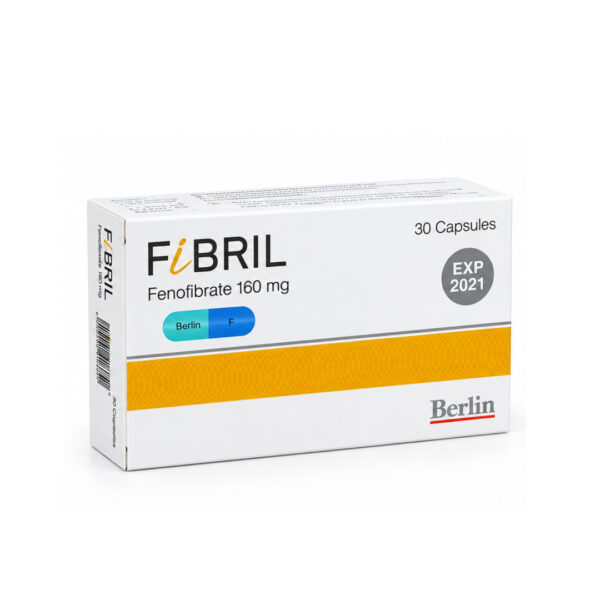
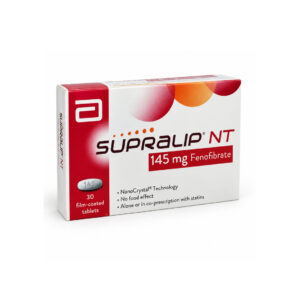
BERLIN FIBRIL 160MG 3×10 Tablets (SUPRALIP)
Fenofibrate 160 mg เป็นยาลดไขมันในเลือดกลุ่ม fibrate ใช้ร่วมกับการควบคุมอาหาร การออกกำลังกาย และการลดน้ำหนักตามความเหมาะสม โดยเฉพาะในผู้ที่มี triglycerides สูงมาก หรือ mixed dyslipidaemia บางกลุ่ม ยาช่วยลด triglycerides และ VLDL พร้อมลด LDL-C ในผู้ป่วยบางรายและช่วยเพิ่ม HDL-C ได้เล็กน้อย ที่สำคัญ ฐานข้อมูล อย. ไทยปัจจุบันระบุ FIBRIL ของ Berlin เป็น hard capsule มี Fenofibrate 160 mg ต่อแคปซูล ไม่ใช่ tablet ดังนั้นชื่อสินค้าที่ถูกต้องตามรูปแบบยาควรเป็น BERLIN FIBRIL 160MG 3×10 Capsules. (ข้อมูลยาแห่งชาติ)
การออกฤทธิ์
Fenofibrate เป็น prodrug ที่ถูกเปลี่ยนเป็น fenofibric acid ซึ่งเป็น active metabolite แล้วออกฤทธิ์กระตุ้น peroxisome proliferator-activated receptor alpha (PPAR-α)
การกระตุ้น PPAR-α ทำให้เพิ่มการสลาย lipoproteins ที่มี triglycerides สูง ผ่านการเพิ่ม lipoprotein lipase และลด apoprotein C-III ส่งผลให้ VLDL และ triglycerides ลดลง
นอกจากนี้ยังเพิ่มการสร้าง ApoA-I และ ApoA-II ซึ่งมีส่วนช่วยเพิ่ม HDL-C และสามารถลด total cholesterol, LDL-C และ ApoB ในผู้ป่วยบางกลุ่มได้. (Medicines.org.uk)
ขอบเขตการทำลายเชื้อ
ไม่มี
Fenofibrate ไม่ใช่ยาปฏิชีวนะ ยาต้านไวรัส หรือยาต้านเชื้อรา และไม่มีฤทธิ์ในการกำจัดเชื้อก่อโรค
เภสัชจลนศาสตร์
Fenofibrate ถูก hydrolysed อย่างรวดเร็วหลังรับประทานไปเป็น fenofibric acid ซึ่งเป็น active metabolite หลัก โดยแทบไม่พบ unchanged fenofibrate ในพลาสมา
สำหรับ fenofibrate 160 mg formulations บางชนิด ระดับ fenofibric acid สูงสุดในพลาสมาเกิดประมาณ 4–5 ชั่วโมง หลังรับประทาน และการดูดซึมอาจเพิ่มขึ้นเมื่อรับประทานพร้อมอาหาร ทั้งนี้ระดับการดูดซึมและข้อกำหนดเรื่องอาหาร ขึ้นกับ formulation ของแต่ละผลิตภัณฑ์. (Medicines.org.uk)
Fenofibric acid จับกับ plasma albumin มากกว่า 99% และมี plasma elimination half-life ประมาณ 20 ชั่วโมง
ยาถูกกำจัดส่วนใหญ่ทางปัสสาวะในรูป fenofibric acid และ glucuronide conjugates โดยยาส่วนใหญ่ถูกกำจัดออกจากร่างกายภายในประมาณ 6 วัน. (Medicines.org.uk)
ข้อห้ามใช้
ห้ามใช้ในผู้ที่แพ้ Fenofibrate หรือส่วนประกอบของยา
ตาม fenofibrate 160 mg SmPC ที่ใช้อ้างอิง ห้ามใช้ในผู้ที่มี severe hepatic impairment, มี persistent unexplained liver-function abnormalities หรือ biliary cirrhosis
ห้ามใช้ในผู้ที่มี severe renal impairment โดย eGFR <30 mL/min/1.73 m²
ห้ามใช้ในผู้ที่มี known gallbladder disease
ห้ามใช้ในผู้ที่มี chronic หรือ acute pancreatitis ยกเว้นกรณี acute pancreatitis ที่เกิดจาก severe hypertriglyceridaemia
ผลิตภัณฑ์บาง formulation ที่มี soybean lecithin อาจมีข้อห้ามในผู้แพ้ถั่วลิสงหรือถั่วเหลือง ดังนั้นควรตรวจสอบ excipients ของ FIBRIL บนฉลากจริงก่อนใช้. (Medicines.org.uk)
ข้อความระวัง
Fenofibrate อาจทำให้ serum transaminases เพิ่มขึ้น จึงควรติดตาม liver function โดยเฉพาะในช่วงแรกของการรักษา
ควรหยุดยาเมื่อ transaminases สูงต่อเนื่องมากกว่า 3 เท่าของ ULN หรือมีอาการบ่งชี้ hepatic injury
Fenofibrate อาจทำให้ serum creatinine เพิ่มขึ้นแบบ reversible ได้ จึงควรติดตาม renal function โดยเฉพาะในผู้สูงอายุ ผู้ป่วยเบาหวาน และผู้ที่มี renal impairment. (Medicines.org.uk)
อาจเกิด myopathy หรือ rhabdomyolysis ได้ โดยความเสี่ยงสูงขึ้นในผู้ที่มี renal impairment, hypothyroidism, อายุสูง หรือใช้ statin/fibrate อื่นร่วมกัน
หากมีอาการปวดกล้ามเนื้อ กล้ามเนื้ออ่อนแรง หรือกดเจ็บผิดปกติ ควรได้รับการประเมินและพิจารณาตรวจ CK
Fenofibrate เพิ่ม cholesterol excretion ในน้ำดี จึงอาจเพิ่มความเสี่ยง gallstones
มีรายงาน pancreatitis ระหว่างใช้ fibrates ซึ่งอาจเกิดจาก lack of efficacy ใน severe hypertriglyceridaemia, direct drug effect หรือ gallstone-related biliary obstruction. (Medicines.org.uk)
การใช้ยาในระยะตั้งครรภ์และให้นมบุตร
การตั้งครรภ์: ข้อมูลในหญิงตั้งครรภ์ยังมีจำกัด Fenofibrate ควรใช้ในระหว่างตั้งครรภ์เฉพาะเมื่อแพทย์ประเมินแล้วว่า ประโยชน์มากกว่าความเสี่ยง. (Medicines.org.uk)
การให้นมบุตร: ยังไม่ทราบแน่ชัดว่า Fenofibrate หรือ metabolites ถูกขับออกทางน้ำนมหรือไม่ และไม่สามารถตัดความเสี่ยงต่อทารกได้ ดังนั้น ไม่ควรใช้ระหว่างให้นมบุตร ตาม SmPC ที่ใช้อ้างอิง. (Medicines.org.uk)
อาการข้างเคียง
อาการที่พบได้ ได้แก่ ปวดท้อง คลื่นไส้ อาเจียน ท้องเสีย ท้องอืด และอาการทางระบบทางเดินอาหาร
อาจพบ transaminases เพิ่มขึ้น, serum creatinine เพิ่มขึ้น และ homocysteine เพิ่มขึ้น
อาการสำคัญที่ต้องระวัง ได้แก่ myopathy, rhabdomyolysis, gallstones, pancreatitis, hepatitis และ hypersensitivity reactions
มีรายงาน thromboembolic events เช่น pulmonary embolism และ deep-vein thrombosis ได้ในผู้ป่วยบางราย แม้พบไม่บ่อย. (Medicines.org.uk)
การได้รับยาเกินขนาด
ไม่มี specific antidote สำหรับ Fenofibrate overdose
การรักษาเป็นแบบ supportive และ symptomatic พร้อมติดตาม renal function, liver function, CK และภาวะแทรกซ้อนอื่นตามอาการ
Fenofibric acid จับกับ plasma protein สูง จึงไม่น่าจะถูกกำจัดออกได้อย่างมีประสิทธิภาพด้วย haemodialysis
ปฏิกิริยาระหว่างยา
Statins: การใช้ Fenofibrate ร่วมกับ statin อาจเพิ่มความเสี่ยง myopathy และ rhabdomyolysis โดยควรใช้ combination เฉพาะเมื่อประโยชน์ที่คาดว่าจะได้รับมากกว่าความเสี่ยง และควรติดตามอาการกล้ามเนื้ออย่างใกล้ชิด. (Medicines.org.uk)
Oral anticoagulants เช่น warfarin: Fenofibrate อาจเพิ่ม anticoagulant effect จึงอาจจำเป็นต้องลดขนาด anticoagulant และติดตาม INR อย่างใกล้ชิด โดยเฉพาะช่วงเริ่มและหยุด Fenofibrate
Ciclosporin: มีรายงาน severe reversible impairment of renal function เมื่อใช้ร่วมกับ Fenofibrate จึงควรติดตาม renal function อย่างใกล้ชิด
Glitazones: มีรายงาน paradoxical reduction ของ HDL-C อย่างรุนแรงในผู้ป่วยบางรายที่ใช้ fibrate ร่วมกับ thiazolidinediones จึงควรติดตาม HDL-C
Fenofibrate อาจยับยั้ง CYP2C9 ในระดับหนึ่ง จึงควรระวังยาที่มี therapeutic index แคบและ metabolized ผ่าน CYP2C9. (Medicines.org.uk)
ชื่อและความแรงของยา (Drug Name and Strength)
Fenofibrate 160 mg per hard capsule
สำนักงานคณะกรรมการอาหารและยาไทยระบุ FIBRIL ของบริษัท เบอร์ลินฟาร์มาซูติคอลอินดัสตรี้ จำกัด เป็น hard capsule มี Fenofibrate 160 mg ต่อแคปซูล. (ข้อมูลยาแห่งชาติ)
ข้อมูลทะเบียนของหน่วยงานกำกับยาใน สปป.ลาว สำหรับผลิตภัณฑ์ FIBRIL ที่ผลิตโดย Berlin ระบุส่วนประกอบเป็น Fenofibrate pellets เทียบเท่า Fenofibrate 160 mg, บรรจุใน ALU-PVC blister แผงละ 10 แคปซูล และ 3 แผงต่อกล่อง ซึ่งสอดคล้องกับขนาดบรรจุ 30 แคปซูลที่ผู้ใช้ระบุ. (FDD)
ดังนั้นผลิตภัณฑ์นี้ตามข้อมูลที่ตรวจสอบควรเรียกว่า capsule ไม่ใช่ tablet
และแม้ผู้ใช้จะระบุ “(SUPRALIP)” เพื่อสื่อถึงผลิตภัณฑ์อ้างอิง แต่ SUPRALIP 160 mg ในปัจจุบันเป็น film-coated tablet formulation จึงไม่ควรสรุปว่า FIBRIL capsule กับ SUPRALIP tablet สามารถแทนกันแบบ mg-for-mg ได้โดยอัตโนมัติหากไม่มีข้อมูล bioequivalence ของ formulation ที่ตรงกัน. (Medicines.org.uk)
ข้อบ่งใช้ (Indications)
Fenofibrate ใช้ร่วมกับการควบคุมอาหาร การออกกำลังกาย และการลดน้ำหนักตามความเหมาะสมสำหรับ:
Severe hypertriglyceridaemia ไม่ว่าจะมี HDL-C ต่ำร่วมด้วยหรือไม่
Mixed hyperlipidaemia ในกรณีที่ statin มีข้อห้ามหรือผู้ป่วยไม่สามารถทนต่อ statin ได้
Mixed hyperlipidaemia ในผู้ที่มี cardiovascular risk สูง โดยใช้ร่วมกับ statin เมื่อ triglycerides และ HDL-C ยังควบคุมได้ไม่เพียงพอ. (Medicines.org.uk)
ข้อมูลการขึ้นทะเบียนของ FIBRIL ในต่างประเทศที่ผลิตโดย Berlin ยังระบุการใช้ใน hypercholesterolaemia, hypertriglyceridaemia และ mixed dyslipidaemia ที่ตอบสนองต่อ diet และ non-pharmacological interventions ไม่เพียงพอ. (FDD)
ขนาดยาแนะนำ (Recommended Dosage)
ขนาดของ Fenofibrate ขึ้นกับ formulation และไม่ควรเทียบขนาดระหว่าง capsule, micronized tablet, suprabioavailable tablet และ nanoparticle formulations โดยอัตโนมัติ
สำหรับ Fenofibrate 160 mg formulations ที่ออกแบบให้ใช้วันละครั้ง ขนาดอ้างอิงในผู้ใหญ่โดยทั่วไปคือ:
Fenofibrate 160 mg วันละครั้ง
มาตรการด้านอาหารที่เริ่มไว้ก่อนใช้ยาควรทำต่อเนื่องระหว่างการรักษา และควรติดตาม lipid profile เพื่อประเมินการตอบสนอง. (Medicines.org.uk)
สำหรับผลิตภัณฑ์ Supralip 160 mg reference formulation ระบุให้รับประทาน พร้อมมื้ออาหาร แต่เนื่องจาก FIBRIL เป็น hard capsule formulation จึงควรยึด ฉลาก FIBRIL ของ Berlin โดยตรงสำหรับคำแนะนำเรื่องอาหาร มากกว่านำวิธีใช้ของ SUPRALIP tablet มาใช้แทน. (Medicines.org.uk)
ในผู้ที่มี eGFR 30–59 mL/min/1.73 m² ควรใช้ขนาด Fenofibrate ที่ต่ำกว่า และ 160 mg มักไม่ใช่ขนาดที่เหมาะสมตาม SmPC อ้างอิง
ห้ามใช้ในผู้ที่มี eGFR <30 mL/min/1.73 m². (Medicines.org.uk)
คำเตือนตามประกาศคำเตือนสาธารณะ (Warnings in Accordance with Public Safety Announcements)
หากมี ปวดกล้ามเนื้อ กล้ามเนื้ออ่อนแรง หรือกดเจ็บผิดปกติ โดยเฉพาะร่วมกับไข้ อ่อนเพลีย หรือปัสสาวะสีเข้ม ควรเข้ารับการประเมิน เพราะอาจเกิด myopathy หรือ rhabdomyolysis
ผู้ที่ใช้ Fenofibrate ร่วมกับ statin ต้องระวัง muscle toxicity มากขึ้น
ควรติดตาม renal function โดยเฉพาะในผู้สูงอายุ ผู้ป่วยเบาหวาน หรือผู้ที่มีไตทำงานลดลง
หากมี ตัวเหลือง ตาเหลือง ปัสสาวะเข้ม ปวดชายโครงขวา หรือ liver enzymes สูงผิดปกติอย่างต่อเนื่อง ควรได้รับการประเมิน hepatic injury
หากมีอาการปวดท้องส่วนบนรุนแรง คลื่นไส้อาเจียน หรือปวดร้าวไปหลัง ควรได้รับการประเมิน pancreatitis หรือ gallstone disease. (Medicines.org.uk)
ภาวะการเก็บรักษา (Storage Conditions)
ฐานข้อมูล อย. ไทยที่ตรวจสอบยืนยันชื่อผลิตภัณฑ์ ความแรง รูปแบบยา และผู้ผลิตของ FIBRIL 160 mg แต่ไม่ได้แสดง storage condition เฉพาะผลิตภัณฑ์อย่างชัดเจน. (ข้อมูลยาแห่งชาติ)
ดังนั้นควรยึด ฉลากและเอกสารกำกับ FIBRIL ของ Berlin ที่มากับผลิตภัณฑ์จริงในประเทศไทยเป็นหลัก
ข้อมูล MIMS สำหรับ Fenofibrate โดยทั่วไประบุเก็บที่ 15–30°C ป้องกันแสงและความชื้น แต่ไม่ควรถือเป็นข้อกำหนดเฉพาะของ FIBRIL หากฉลาก Berlin ระบุแตกต่างกัน. (MIMS)
แหล่งข้อมูลอ้างอิง
ในประเทศ
สำนักงานคณะกรรมการอาหารและยา — FIBRIL 160 mg
MIMS Thailand — Fenofibrate
ต่างประเทศ
Viatris / emc — Supralip 160 mg SmPC
emc — Fenofibrate 160 mg Tablets SmPC
หมายเหตุสำคัญ: ข้อมูลนี้จัดทำขึ้นเพื่อให้ความรู้เบื้องต้นเกี่ยวกับยาเท่านั้น ไม่สามารถใช้แทนการวินิจฉัย การรักษา หรือคำแนะนำจากบุคลากรทางการแพทย์ได้ การเลือกใช้ยา ขนาดยา และระยะเวลาการรักษาอาจแตกต่างกันในแต่ละบุคคล โปรดปรึกษาแพทย์หรือเภสัชกรก่อนใช้ยาทุกครั้ง และไม่ควรปรับขนาดยา หยุดยา หรือใช้ยาร่วมกับยาอื่นด้วยตนเอง เพื่อความปลอดภัยในการใช้ยา
BERLIN FIBRIL 160MG 3×10 Tablets (SUPRALIP)
Fenofibrate 160 mg is a fibric acid derivative (fibrate) used with dietary and other lifestyle measures, particularly for severe hypertriglyceridaemia and selected patients with mixed dyslipidaemia. It primarily reduces triglyceride-rich lipoproteins and may reduce LDL-C and increase HDL-C in appropriate patients. Importantly, the current Thai FDA record identifies Berlin FIBRIL 160 mg as a hard capsule, not a tablet. Therefore, the dosage form is more accurately described as BERLIN FIBRIL 160MG 3×10 Capsules. (ข้อมูลยาแห่งชาติ)
Mechanism of Action
Fenofibrate is rapidly converted to its active metabolite, fenofibric acid, which activates peroxisome proliferator-activated receptor alpha (PPAR-α).
PPAR-α activation increases lipoprotein lipase activity and decreases ApoC-III production, enhancing clearance of triglyceride-rich lipoproteins.
Treatment therefore reduces triglycerides and VLDL, may reduce LDL-C and ApoB, and can modestly increase HDL-C through increased ApoA-I and ApoA-II synthesis. (Medicines.org.uk)
Antimicrobial Spectrum
None.
Fenofibrate has no antibacterial, antiviral, or antifungal activity.
Pharmacokinetics
Fenofibrate is rapidly hydrolysed after administration to fenofibric acid, the principal active metabolite. Unchanged Fenofibrate is essentially absent from plasma.
For certain 160 mg formulations, peak fenofibric acid concentrations occur approximately 4–5 hours after administration. Food may increase absorption, although food effects vary according to the specific formulation. (Medicines.org.uk)
Fenofibric acid is more than 99% albumin bound and has a plasma elimination half-life of approximately 20 hours.
Elimination is primarily renal as fenofibric acid and glucuronide conjugates, with most drug eliminated within approximately 6 days. (Medicines.org.uk)
Contraindications
Fenofibrate is contraindicated in patients with hypersensitivity to the active substance or product excipients.
The referenced 160 mg SmPC contraindicates treatment in severe hepatic impairment, persistent unexplained liver-function abnormalities, and biliary cirrhosis.
It is contraindicated in severe renal impairment with eGFR <30 mL/min/1.73 m².
It is also contraindicated in patients with known gallbladder disease and in patients with chronic or acute pancreatitis, except acute pancreatitis secondary to severe hypertriglyceridaemia. (Medicines.org.uk)
Some Fenofibrate formulations contain soybean-derived excipients; the actual FIBRIL excipient list should therefore be checked before applying any soy- or peanut-allergy contraindication.
Precautions
Fenofibrate may cause elevations in hepatic transaminases, and liver-function monitoring is recommended.
Persistent elevations exceeding three times the upper limit of normal or symptoms consistent with hepatic injury generally warrant discontinuation.
Fenofibrate may cause a reversible increase in serum creatinine, making renal-function monitoring particularly important in older adults, patients with diabetes, and those with pre-existing renal impairment. (Medicines.org.uk)
Myopathy and rhabdomyolysis may occur, with increased risk in renal impairment, hypothyroidism, advanced age, and during concomitant statin or fibrate therapy.
Fenofibrate may increase biliary cholesterol excretion and consequently the risk of gallstone formation.
Pancreatitis has also been reported during fibrate treatment. (Medicines.org.uk)
Use During Pregnancy and Breastfeeding
Pregnancy: Human data are limited. Fenofibrate should be used during pregnancy only after careful assessment of the expected benefit versus potential risk. (Medicines.org.uk)
Breastfeeding: It is unknown whether Fenofibrate or its metabolites are excreted in human milk. Because a risk to the nursing infant cannot be excluded, the referenced SmPC advises against Fenofibrate during breastfeeding. (Medicines.org.uk)
Adverse Effects
Adverse effects may include abdominal pain, nausea, vomiting, diarrhoea, flatulence, and other gastrointestinal symptoms.
Laboratory abnormalities may include increased hepatic transaminases, serum creatinine, and homocysteine.
Clinically important adverse reactions include myopathy, rhabdomyolysis, gallstones, pancreatitis, hepatitis, and hypersensitivity reactions.
Venous thromboembolic events such as pulmonary embolism and deep-vein thrombosis have also been reported, although they are uncommon. (Medicines.org.uk)
Overdose
There is no specific antidote for Fenofibrate overdose.
Management consists of supportive and symptomatic treatment, including appropriate monitoring of renal, hepatic, and muscular status.
Because fenofibric acid is highly protein bound, haemodialysis is unlikely to provide substantial removal.
Drug Interactions
Statins: Concomitant Fenofibrate and statin therapy may increase the risk of myopathy and rhabdomyolysis and should be used only after careful benefit-risk assessment. (Medicines.org.uk)
Oral anticoagulants such as warfarin: Fenofibrate may potentiate anticoagulant effects. Anticoagulant dose reduction and close INR monitoring may be required.
Ciclosporin: Severe reversible renal impairment has been reported. Renal function should be closely monitored.
Thiazolidinediones: Marked paradoxical reductions in HDL-C have been reported in some patients receiving fibrates with glitazones.
Fenofibrate may inhibit CYP2C9 to some degree; medicines with a narrow therapeutic index metabolised through CYP2C9 require additional caution. (Medicines.org.uk)
Drug Name and Strength
Fenofibrate 160 mg per hard capsule
The Thai FDA identifies FIBRIL from Berlin Pharmaceutical Industry Co., Ltd. as a hard capsule containing Fenofibrate 160 mg per capsule. (ข้อมูลยาแห่งชาติ)
A regulatory record for the Berlin-manufactured FIBRIL product in Laos specifies fenofibrate pellets equivalent to Fenofibrate 160 mg, packaged in ALU-PVC blisters containing 10 capsules, with 3 blisters per box, consistent with a 30-capsule pack. (FDD)
Therefore, the verified dosage form is capsule rather than tablet.
Although the user has included “SUPRALIP” as a reference brand, current Supralip 160 mg is a film-coated tablet formulation. The two products should not automatically be assumed to be interchangeable milligram-for-milligram unless formulation-specific equivalence has been established. (Medicines.org.uk)
Indications
Fenofibrate is indicated as an adjunct to diet and other non-pharmacological treatment for:
Severe hypertriglyceridaemia, with or without low HDL-C.
Mixed hyperlipidaemia when a statin is contraindicated or not tolerated.
Mixed hyperlipidaemia in high-cardiovascular-risk patients in addition to a statin when triglycerides and HDL-C remain inadequately controlled. (Medicines.org.uk)
Regulatory information for the Berlin-manufactured FIBRIL product also describes use for hypercholesterolaemia, hypertriglyceridaemia, or mixed dyslipidaemia inadequately controlled by diet and other non-pharmacological measures. (FDD)
Recommended Dosage
Fenofibrate dosage is formulation-dependent. Capsules, conventional tablets, micronised formulations, suprabioavailable tablets, and nanoparticle formulations should not automatically be considered dose-equivalent.
For appropriately formulated 160 mg products, a commonly referenced adult dose is:
Fenofibrate 160 mg once daily
Dietary measures should be continued throughout therapy, and serum lipid values should be monitored to assess response. (Medicines.org.uk)
The current Supralip 160 mg reference tablet is administered with a meal. Because FIBRIL is a hard capsule formulation, the Berlin FIBRIL package insert should take precedence for food-related administration instructions rather than automatically applying Supralip tablet instructions. (Medicines.org.uk)
In patients with eGFR 30–59 mL/min/1.73 m², a lower Fenofibrate dose is generally required, and a 160 mg dose is usually inappropriate under the referenced SmPC.
Fenofibrate should not be used when eGFR is below 30 mL/min/1.73 m². (Medicines.org.uk)
Warnings in Accordance with Public Safety Announcements
Patients should promptly report unexplained muscle pain, weakness, or tenderness, particularly when accompanied by fever, marked fatigue, or dark urine.
Muscle toxicity risk is increased when Fenofibrate is combined with a statin.
Renal function should be monitored, particularly in older adults, patients with diabetes, and those with impaired renal function.
Symptoms suggesting hepatic injury, including jaundice, dark urine, loss of appetite, or right-upper-quadrant discomfort, require medical assessment.
Severe upper abdominal pain, particularly with nausea, vomiting, or radiation to the back, warrants assessment for pancreatitis or gallstone disease. (Medicines.org.uk)
Storage Conditions
The retrieved Thai FDA record confirms the identity, strength, dosage form, and manufacturer of FIBRIL 160 mg, but does not clearly display product-specific storage instructions. (ข้อมูลยาแห่งชาติ)
The Thai marketed Berlin FIBRIL package label and local package insert should therefore take precedence.
MIMS provides general Fenofibrate storage guidance of 15–30°C, protected from light and moisture, but this should not automatically replace FIBRIL-specific Thai instructions if the actual product label differs. (MIMS)
References
Thailand
Thai FDA — FIBRIL 160 mg
MIMS Thailand — Fenofibrate
International
Viatris / emc — Supralip 160 mg SmPC
emc — Fenofibrate 160 mg Tablets SmPC
Important Notice: This information is provided for general educational purposes only and is not intended to replace professional medical diagnosis, treatment, or advice. The appropriate medicine, dosage, and duration of treatment may vary from person to person. Always consult a doctor or pharmacist before using any medication. Do not change the dose, stop treatment, or combine medicines on your own without professional advice.