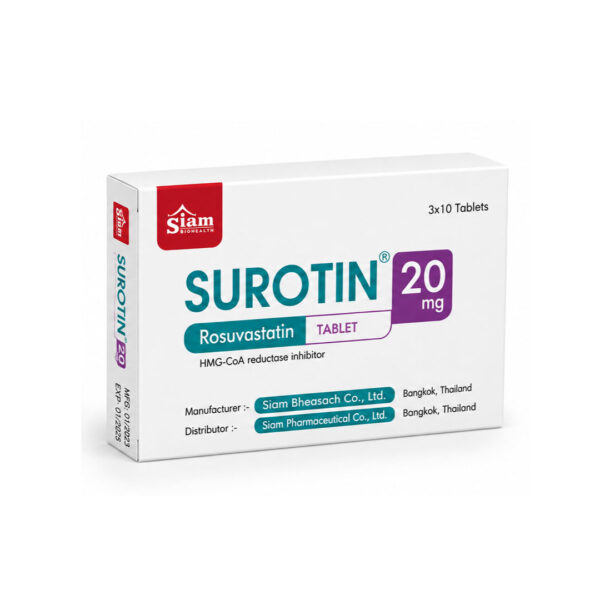
SIAM SUROTIN 20MG 3×10 Tablets (CRESTOR)
Rosuvastatin 20 mg เป็นยาลดไขมันในเลือดกลุ่ม statin (HMG-CoA reductase inhibitor) ใช้ลด LDL-C และไขมันชนิดอื่น รวมถึงช่วยลดความเสี่ยงของ cardiovascular events ในผู้ป่วยที่เหมาะสม โดยออกฤทธิ์ลดการสร้าง cholesterol ที่ตับและเพิ่มการกำจัด LDL ออกจากกระแสเลือด ผลิตภัณฑ์ SUROTIN 20 MG TABLET ที่ขึ้นทะเบียนในประเทศไทยเป็น Rosuvastatin 20 mg tablet ของบริษัท สยามเภสัช จำกัด. (ข้อมูลยาแห่งชาติ)
การออกฤทธิ์
Rosuvastatin ออกฤทธิ์เป็น selective competitive inhibitor ของ HMG-CoA reductase ซึ่งเป็นเอนไซม์สำคัญในกระบวนการสร้าง cholesterol ที่ตับ
เมื่อ hepatic cholesterol ลดลง ตับจะเพิ่มจำนวน LDL receptors บนผิวเซลล์ ทำให้มีการจับและกำจัด LDL-C ออกจากกระแสเลือดมากขึ้น พร้อมกับลดการสร้าง VLDL จึงช่วยลด LDL-C, total cholesterol, triglycerides และ ApoB และสามารถเพิ่ม HDL-C ได้เล็กน้อย. (DailyMed)
ขอบเขตการทำลายเชื้อ
ไม่มี
Rosuvastatin ไม่ใช่ยาปฏิชีวนะ ยาต้านไวรัส หรือยาต้านเชื้อรา และไม่มีฤทธิ์ในการกำจัดเชื้อก่อโรค
เภสัชจลนศาสตร์
หลังรับประทาน Rosuvastatin ระดับสูงสุดในเลือดเกิดประมาณ 3–5 ชั่วโมง และมี absolute bioavailability ประมาณ 20%
Rosuvastatin จับกับ plasma protein ประมาณ 88% โดยส่วนใหญ่จับกับ albumin
ยาถูก metabolized เพียงประมาณ 10% และไม่ได้พึ่ง CYP3A4 เป็นหลัก โดย metabolism ที่สำคัญเกี่ยวข้องกับ CYP2C9 และในระดับน้อยกับ CYP2C19
Rosuvastatin ส่วนใหญ่ถูกขับออกทางอุจจาระในรูปยาเดิม และมี elimination half-life ประมาณ 19 ชั่วโมง
ผู้ป่วยเชื้อสายเอเชียอาจมี systemic exposure ต่อ Rosuvastatin สูงกว่าผู้ป่วยผิวขาวประมาณ 2 เท่า ซึ่งเป็นเหตุผลที่ฉลาก CRESTOR ของสหรัฐฯ แนะนำให้เริ่มขนาดต่ำกว่าในผู้ป่วยเอเชีย. (DailyMed)
ข้อห้ามใช้
ห้ามใช้ในผู้ที่มีประวัติแพ้ Rosuvastatin หรือส่วนประกอบของยา
ตามข้อมูลผลิตภัณฑ์สากลหลายประเทศ ห้ามใช้ในผู้ที่มี active liver disease รวมถึง persistent unexplained elevations of serum transaminases ในระดับที่มีนัยสำคัญ
ข้อกำหนดเกี่ยวกับการตั้งครรภ์แตกต่างตามประเทศ ปัจจุบันฉลาก CRESTOR ของสหรัฐฯ ไม่ได้ถือการตั้งครรภ์เป็น absolute contraindication แบบเดิม แต่ระบุให้ หยุดยาเมื่อทราบว่าตั้งครรภ์ในผู้ป่วยส่วนใหญ่ และประเมินความจำเป็นเป็นรายบุคคล. (DailyMed)
ข้อความระวัง
Rosuvastatin อาจทำให้เกิด myopathy และ rhabdomyolysis ซึ่งพบไม่บ่อยแต่สามารถรุนแรงและทำให้ acute kidney injury ได้
ปัจจัยที่เพิ่มความเสี่ยง ได้แก่ อายุ ≥65 ปี, uncontrolled hypothyroidism, renal impairment, ขนาด Rosuvastatin ที่สูง และการใช้ยาบางชนิดร่วมกัน โดยผู้ป่วยเอเชียอาจมีความเสี่ยงเพิ่มขึ้นเนื่องจากระดับยาในเลือดสูงกว่า. (DailyMed)
หากมีอาการ ปวดกล้ามเนื้อ กล้ามเนื้ออ่อนแรง หรือกดเจ็บผิดปกติ โดยเฉพาะร่วมกับไข้หรืออ่อนเพลีย ควรได้รับการประเมินและอาจต้องตรวจ creatine kinase (CK)
มีรายงาน immune-mediated necrotizing myopathy (IMNM) ซึ่งเป็น autoimmune myopathy ที่อาจยังคงมีอาการแม้หยุด statin แล้ว และต้องได้รับการประเมินเฉพาะทาง
Rosuvastatin อาจทำให้ hepatic transaminases เพิ่มขึ้น ควรตรวจ liver enzymes ก่อนเริ่มยาและตรวจเพิ่มเติมหากมีอาการสงสัย liver injury
อาจพบ proteinuria และ microscopic haematuria โดยเฉพาะขนาดสูง ซึ่งส่วนใหญ่มักไม่สัมพันธ์กับ progressive renal disease
Statins อาจเพิ่ม fasting glucose และ HbA1c เล็กน้อย จึงควรติดตามในผู้ที่มีความเสี่ยงต่อ diabetes mellitus. (DailyMed)
การใช้ยาในระยะตั้งครรภ์และให้นมบุตร
การตั้งครรภ์: ฉลาก CRESTOR ของสหรัฐฯ ปี 2026 ระบุให้ หยุด Rosuvastatin เมื่อทราบว่าตั้งครรภ์ในผู้ป่วยส่วนใหญ่ เพราะยาลดการสังเคราะห์ cholesterol ซึ่งเป็นสารสำคัญต่อพัฒนาการของทารก อย่างไรก็ตามในผู้ป่วยที่มีความเสี่ยง cardiovascular สูงมากอาจต้องพิจารณาความจำเป็นในการรักษาเป็นรายบุคคลโดยแพทย์. (DailyMed)
การให้นมบุตร: ฉลาก CRESTOR ระบุว่า ไม่แนะนำให้นมบุตรระหว่างใช้ยา เนื่องจากมีความเสี่ยงต่อทารกและมีทางเลือกในการให้อาหารทารกอื่นในกรณีที่มารดาจำเป็นต้องได้รับ Rosuvastatin. (DailyMed)
อาการข้างเคียง
อาการที่อาจพบได้ ได้แก่ ปวดศีรษะ เวียนศีรษะ ปวดกล้ามเนื้อ ปวดท้อง คลื่นไส้ ท้องผูก และอ่อนเพลีย
อาจพบ ค่าเอนไซม์ตับเพิ่มขึ้น, CK เพิ่มขึ้น, proteinuria หรือ haematuria
อาการสำคัญที่ต้องระวัง ได้แก่ myopathy, rhabdomyolysis, immune-mediated necrotizing myopathy, hepatic injury และ hypersensitivity reactions
อาจพบ glucose หรือ HbA1c เพิ่มขึ้นในผู้ป่วยบางราย. (DailyMed)
การได้รับยาเกินขนาด
ไม่มี specific antidote สำหรับ Rosuvastatin overdose
การรักษาเป็นแบบ supportive และ symptomatic พร้อมติดตาม liver function, renal function, CK และสัญญาณชีพตามอาการ
เนื่องจาก Rosuvastatin จับกับ plasma protein และมีคุณสมบัติทางเภสัชจลนศาสตร์เฉพาะ การทำ haemodialysis ไม่น่าจะเพิ่มการกำจัดยาได้อย่างมีนัยสำคัญ
ปฏิกิริยาระหว่างยา
Rosuvastatin เป็น substrate ของ transport proteins โดยเฉพาะ OATP1B1 และ BCRP ดังนั้นยาที่รบกวน transporters เหล่านี้สามารถเพิ่มระดับ Rosuvastatin ได้
ควรหลีกเลี่ยงการใช้ร่วมกับ gemfibrozil หากหลีกเลี่ยงไม่ได้ ฉลากสหรัฐฯ แนะนำเริ่ม Rosuvastatin 5 mg และไม่เกิน 10 mg/day. (DailyMed)
เมื่อใช้ร่วมกับ cyclosporine ระดับ Rosuvastatin สามารถเพิ่มได้ประมาณ 7 เท่า และฉลากสหรัฐฯ จำกัดขนาดไม่เกิน 5 mg/day. (DailyMed)
ยาบางชนิด เช่น darolutamide, capmatinib, regorafenib, teriflunomide, ticagrelor, febuxostat, fostamatinib และ antiviral agents บางชนิด อาจเพิ่มระดับ Rosuvastatin และต้องจำกัดขนาดยาตามคู่ยาที่ใช้. (DailyMed)
การใช้ร่วมกับ fibrates, colchicine หรือ niacin ขนาดลดไขมัน สามารถเพิ่มความเสี่ยง myopathy และ rhabdomyolysis จึงต้องติดตามอาการอย่างใกล้ชิด. (DailyMed)
ยาลดกรดที่มี aluminium hydroxide/magnesium hydroxide อาจลดระดับ Rosuvastatin ควรแยกเวลารับประทานตามคำแนะนำของผลิตภัณฑ์
Rosuvastatin อาจเพิ่ม INR ในผู้ที่ใช้ warfarin หรือ vitamin K antagonists จึงควรติดตาม INR เมื่อเริ่ม หยุด หรือปรับขนาด Rosuvastatin
ชื่อและความแรงของยา (Drug Name and Strength)
Rosuvastatin 20 mg per tablet
ผลิตภัณฑ์ SUROTIN (20 MG TABLET) ที่ขึ้นทะเบียนในประเทศไทยมีตัวยาสำคัญ Rosuvastatin 20 mg ต่อเม็ด และบริษัท สยามเภสัช จำกัด เป็นผู้รับอนุญาต โดยฐานข้อมูล อย. ระบุผลิตภัณฑ์เป็น Rosuvastatin 20 mg film-coated tablet. (ข้อมูลยาแห่งชาติ)
Green Book ของกรมวิทยาศาสตร์การแพทย์ยังระบุ SUROTIN 20 mg ของ Siam Bheasach Co., Ltd. ในรายการ Rosuvastatin tablets. (BDN)
ขนาดบรรจุตามที่ระบุคือ 3 × 10 Tablets = 30 เม็ด
ข้อบ่งใช้ (Indications)
Rosuvastatin ใช้ร่วมกับการควบคุมอาหารและการปรับพฤติกรรมเพื่อรักษา primary hypercholesterolaemia และ mixed dyslipidaemia โดยช่วยลด LDL-C, total cholesterol, non-HDL-C, ApoB และ triglycerides
ใช้รักษา familial hypercholesterolaemia ทั้ง heterozygous และ homozygous ในผู้ป่วยที่เหมาะสม
สามารถใช้เพื่อ ชะลอการดำเนินของ atherosclerosis และลดความเสี่ยง cardiovascular events ในผู้ใหญ่ที่มีความเสี่ยงตามข้อบ่งใช้ของผลิตภัณฑ์อ้างอิง
ฉลาก CRESTOR สหรัฐฯ ฉบับปรับปรุงปี 2026 ระบุข้อบ่งใช้เพื่อลดความเสี่ยง cardiovascular death, nonfatal myocardial infarction, nonfatal stroke และ arterial revascularization ในผู้ใหญ่ที่มีความเสี่ยง cardiovascular events เพิ่มขึ้น. (DailyMed)
ขนาดยาแนะนำ (Recommended Dosage)
ช่วงขนาดสำหรับผู้ใหญ่โดยทั่วไปคือ:
Rosuvastatin 5–40 mg วันละครั้ง
สามารถรับประทาน เวลาใดก็ได้ของวัน พร้อมหรือไม่พร้อมอาหารก็ได้
ขนาดยาควรเลือกตาม LDL-C เริ่มต้น เป้าหมายการรักษา cardiovascular risk การตอบสนอง และความเสี่ยงต่อ adverse effects. (DailyMed)
สำหรับ ผู้ป่วยชาวเอเชีย ฉลาก CRESTOR ของสหรัฐฯ แนะนำ:
เริ่มต้น 5 mg วันละครั้ง
เนื่องจาก systemic exposure ต่อ Rosuvastatin สูงกว่าประชากรผิวขาว และควรพิจารณาประโยชน์และความเสี่ยงอย่างรอบคอบเมื่อต้องใช้ขนาดสูงถึง 20 mg/day. (DailyMed)
ดังนั้น SUROTIN 20 mg เป็นความแรงสูงกว่าขนาดเริ่มต้นที่แนะนำสำหรับผู้ป่วยเอเชีย และควรใช้ตามการประเมินของแพทย์ ไม่ควรเริ่มขนาด 20 mg ด้วยตนเอง
ในผู้ที่มี severe renal impairment (CrCl <30 mL/min/1.73 m²) และไม่ได้ฟอกไต ฉลาก CRESTOR สหรัฐฯ แนะนำเริ่ม 5 mg/day และไม่เกิน 10 mg/day ดังนั้น Rosuvastatin 20 mg ไม่เหมาะกับผู้ป่วยกลุ่มนี้ตามฉลากดังกล่าว. (DailyMed)
ผู้ที่มี mild-to-moderate renal impairment โดยทั่วไปไม่ต้องปรับขนาดยาตามฉลากสหรัฐฯ. (DailyMed)
คำเตือนตามประกาศคำเตือนสาธารณะ (Warnings in Accordance with Public Safety Announcements)
หากมี ปวดกล้ามเนื้อ กล้ามเนื้ออ่อนแรง หรือกดเจ็บอย่างผิดปกติ โดยเฉพาะเมื่อมีไข้ อ่อนเพลีย หรือปัสสาวะสีเข้ม ควรเข้ารับการประเมินทันที เพราะอาจเป็น myopathy หรือ rhabdomyolysis. (DailyMed)
ผู้ที่มีอายุ ≥65 ปี, renal impairment, hypothyroidism ที่ควบคุมไม่ได้ หรือใช้ยาที่เพิ่มระดับ Rosuvastatin มีความเสี่ยงต่อ muscle toxicity มากขึ้น
ผู้ป่วยเอเชียอาจมี systemic exposure สูงกว่า จึงควรเริ่มยาที่ขนาดต่ำตาม product labeling และปรับขนาดตาม LDL-C และการตอบสนอง. (DailyMed)
หากมี ตัวเหลือง ตาเหลือง ปัสสาวะเข้ม เบื่ออาหาร หรืออ่อนเพลียมากผิดปกติ ควรเข้ารับการประเมินภาวะ hepatic injury
หญิงที่ตั้งครรภ์ขณะใช้ Rosuvastatin ควรแจ้งแพทย์ โดยฉลากสหรัฐฯ ปัจจุบันแนะนำให้หยุดยาเมื่อทราบว่าตั้งครรภ์ในผู้ป่วยส่วนใหญ่. (DailyMed)
ควรตรวจสอบยาร่วมทุกครั้ง โดยเฉพาะ cyclosporine, gemfibrozil, fibrates, colchicine, antiviral agents และยาที่มีผลต่อ BCRP/OATP1B1 transporters เนื่องจากอาจเพิ่มระดับ Rosuvastatin และความเสี่ยง rhabdomyolysis. (DailyMed)
ภาวะการเก็บรักษา (Storage Conditions)
ฐานข้อมูล อย. ไทยยืนยันว่า SUROTIN เป็น Rosuvastatin 20 mg tablet แต่หน้าข้อมูลสาธารณะที่ตรวจสอบไม่ได้แสดง storage condition เฉพาะของ SUROTIN อย่างชัดเจน จึงควรยึด ฉลากและเอกสารกำกับ SUROTIN ที่จำหน่ายจริงในประเทศไทยเป็นหลัก. (ข้อมูลยาแห่งชาติ)
ไม่ควรนำเงื่อนไขการเก็บรักษาของ CRESTOR หรือ Rosuvastatin ยี่ห้ออื่นมาใช้เป็นเงื่อนไขเฉพาะของ SUROTIN หากยังไม่ได้ยืนยันจากฉลากผลิตภัณฑ์
แหล่งข้อมูลอ้างอิง
ในประเทศ
สำนักงานคณะกรรมการอาหารและยา — SUROTIN 20 MG
กรมวิทยาศาสตร์การแพทย์ — Green Book
ต่างประเทศ
DailyMed — CRESTOR (Rosuvastatin) Prescribing Information
Electronic Medicines Compendium — Rosuvastatin Products
หมายเหตุสำคัญ: ข้อมูลนี้จัดทำขึ้นเพื่อให้ความรู้เบื้องต้นเกี่ยวกับยาเท่านั้น ไม่สามารถใช้แทนการวินิจฉัย การรักษา หรือคำแนะนำจากบุคลากรทางการแพทย์ได้ การเลือกใช้ยา ขนาดยา และระยะเวลาการรักษาอาจแตกต่างกันในแต่ละบุคคล โปรดปรึกษาแพทย์หรือเภสัชกรก่อนใช้ยาทุกครั้ง และไม่ควรปรับขนาดยา หยุดยา หรือใช้ยาร่วมกับยาอื่นด้วยตนเอง เพื่อความปลอดภัยในการใช้ยา
SIAM SUROTIN 20MG 3×10 Tablets (CRESTOR)
Rosuvastatin 20 mg is an HMG-CoA reductase inhibitor (statin) used to reduce LDL-C and other atherogenic lipids and, in appropriate patients, to reduce the risk of major cardiovascular events. It lowers hepatic cholesterol synthesis and increases hepatic clearance of circulating LDL. The Thai-registered SUROTIN 20 MG TABLET contains Rosuvastatin 20 mg and is licensed to Siam Bheasach Co., Ltd. (ข้อมูลยาแห่งชาติ)
Mechanism of Action
Rosuvastatin is a selective competitive inhibitor of HMG-CoA reductase, the rate-limiting enzyme in hepatic cholesterol synthesis.
Reduced hepatic cholesterol increases the number of LDL receptors on hepatocytes, enhancing uptake and catabolism of LDL. Rosuvastatin also reduces hepatic VLDL production, resulting in reductions in LDL-C, total cholesterol, triglycerides, non-HDL-C, and ApoB. (DailyMed)
Antimicrobial Spectrum
None.
Rosuvastatin has no antibacterial, antiviral, or antifungal activity.
Pharmacokinetics
Peak plasma concentrations of Rosuvastatin are generally reached within approximately 3–5 hours after oral administration.
Rosuvastatin is approximately 88% protein bound and undergoes limited metabolism. CYP2C9 is the principal CYP enzyme involved, with a lesser contribution from CYP2C19.
Most of the administered dose is eliminated unchanged in the faeces. The elimination half-life is approximately 19 hours.
Pharmacokinetic studies demonstrate approximately two-fold higher median systemic exposure in Asian subjects compared with White control populations. (DailyMed)
Contraindications
Contraindicated in patients with hypersensitivity to Rosuvastatin or any excipient.
International product information generally contraindicates treatment in patients with active liver disease, including clinically significant unexplained persistent elevations in hepatic transaminases.
Pregnancy recommendations differ by jurisdiction. Current U.S. labeling no longer treats pregnancy as an absolute contraindication but generally recommends discontinuing CRESTOR when pregnancy is recognised, while allowing individual assessment in exceptional high-risk patients. (DailyMed)
Precautions
Rosuvastatin may cause myopathy and rhabdomyolysis, which can result in acute kidney injury.
Risk factors include age 65 years or older, uncontrolled hypothyroidism, renal impairment, interacting medicines, and higher Rosuvastatin doses. Asian patients may have a higher risk because systemic exposure is increased. (DailyMed)
Patients should report unexplained muscle pain, tenderness, or weakness, particularly when accompanied by malaise or fever.
Rare immune-mediated necrotizing myopathy has been reported and may persist despite discontinuation of statin treatment.
Rosuvastatin may cause elevations in hepatic transaminases, proteinuria, microscopic haematuria, and modest increases in fasting glucose or HbA1c in susceptible patients. (DailyMed)
Use During Pregnancy and Breastfeeding
Pregnancy: Current U.S. CRESTOR labeling advises discontinuing Rosuvastatin when pregnancy is recognised in most patients. Continuing therapy may be considered only when the ongoing therapeutic need clearly outweighs potential fetal risk in an exceptional clinical situation. (DailyMed)
Breastfeeding: Breastfeeding is not recommended during CRESTOR treatment. (DailyMed)
Adverse Effects
Adverse effects may include headache, dizziness, myalgia, abdominal pain, nausea, constipation, and asthenia.
Laboratory abnormalities may include elevated transaminases, elevated CK, proteinuria, haematuria, and small increases in glucose or HbA1c.
Clinically important reactions include myopathy, rhabdomyolysis, immune-mediated necrotizing myopathy, hepatic injury, and hypersensitivity reactions.
Overdose
There is no specific antidote for Rosuvastatin overdose.
Management consists of supportive and symptomatic treatment, with appropriate monitoring of muscle, hepatic, renal, and cardiovascular status.
Haemodialysis is unlikely to significantly enhance Rosuvastatin clearance.
Drug Interactions
Rosuvastatin is a substrate of transport proteins including OATP1B1 and BCRP. Inhibition of these transporters may substantially increase Rosuvastatin exposure.
Concomitant gemfibrozil should preferably be avoided. If unavoidable, current U.S. labeling recommends initiating Rosuvastatin at 5 mg and not exceeding 10 mg/day. (DailyMed)
With cyclosporine, Rosuvastatin exposure increases markedly and the U.S. label limits the dose to 5 mg once daily. (DailyMed)
Several other medicines, including darolutamide, capmatinib, regorafenib, teriflunomide, ticagrelor, febuxostat, fostamatinib, and certain antiviral agents, require Rosuvastatin dose limitations. (DailyMed)
Concomitant fibrates, colchicine, or lipid-modifying doses of niacin can increase the risk of myopathy and rhabdomyolysis.
Appropriate INR monitoring should be considered in patients receiving warfarin or other vitamin K antagonists.
Drug Name and Strength
Rosuvastatin 20 mg per tablet
SUROTIN (20 MG TABLET) is registered in Thailand as a Rosuvastatin 20 mg tablet. The Thai FDA lists Siam Bheasach Co., Ltd. as the licence holder, and the public record identifies the product as a Rosuvastatin 20 mg film-coated tablet. (ข้อมูลยาแห่งชาติ)
The Thai Department of Medical Sciences Green Book also lists SUROTIN 20 mg among Rosuvastatin tablet products manufactured by Siam Bheasach Co., Ltd. (BDN)
Specified pack size: 3 × 10 tablets = 30 tablets
Indications
Rosuvastatin is indicated as an adjunct to diet and lifestyle modification for primary hypercholesterolaemia and mixed dyslipidaemia.
It is used in appropriate patients with heterozygous or homozygous familial hypercholesterolaemia.
Rosuvastatin may also be used to slow progression of atherosclerosis and reduce cardiovascular risk in eligible patients.
Current U.S. CRESTOR labeling includes reduction of major cardiovascular events including cardiovascular death, nonfatal myocardial infarction, nonfatal stroke, and arterial revascularisation procedures in adults at increased cardiovascular risk. (DailyMed)
Recommended Dosage
The general adult dosage range is:
Rosuvastatin 5–40 mg once daily
It may be administered at any time of day, with or without food.
Dose selection should be based on the indication, baseline LDL-C, treatment target, cardiovascular risk, clinical response, and risk of adverse reactions. (DailyMed)
For Asian patients, the current U.S. CRESTOR label recommends:
Start with 5 mg once daily
because Rosuvastatin exposure is higher in Asian patients. The risks and benefits should be carefully considered when higher doses, including 20 mg/day, are required. (DailyMed)
Therefore, the 20 mg strength is above the recommended initial dose for Asian patients and should not normally be self-initiated without medical assessment.
In patients with severe renal impairment (CrCl <30 mL/min/1.73 m²) who are not receiving haemodialysis, the recommended starting dose is 5 mg once daily and the dose should not exceed 10 mg once daily. (DailyMed)
No dosage adjustment is generally required for mild-to-moderate renal impairment. (DailyMed)
Warnings in Accordance with Public Safety Announcements
Patients should promptly report unexplained muscle pain, tenderness, or weakness, particularly when accompanied by fever, marked fatigue, or dark urine, because myopathy or rhabdomyolysis may occur. (DailyMed)
Patients aged 65 years or older, those with renal impairment or uncontrolled hypothyroidism, and those receiving interacting medicines have an increased risk of muscle toxicity.
Asian patients have higher systemic Rosuvastatin exposure and should generally start at a lower dose, with subsequent titration based on lipid response and tolerability. (DailyMed)
Symptoms suggestive of hepatic injury, including jaundice, dark urine, marked fatigue, or loss of appetite, require medical assessment.
Patients who become pregnant should inform their healthcare professional. Current U.S. labeling recommends discontinuing treatment when pregnancy is recognised in most patients. (DailyMed)
Concomitant medicines should be reviewed carefully, particularly cyclosporine, gemfibrozil, fibrates, colchicine, antiviral agents, and medicines affecting OATP1B1 or BCRP transporters. (DailyMed)
Storage Conditions
The Thai FDA confirms that SUROTIN is a Rosuvastatin 20 mg tablet, but the retrieved public record does not clearly display product-specific storage conditions. The marketed SUROTIN label and Thai product insert should therefore take precedence. (ข้อมูลยาแห่งชาติ)
Storage instructions from CRESTOR or another Rosuvastatin brand should not be treated as SUROTIN-specific unless confirmed on the actual SUROTIN packaging.
References
Thailand
Thai FDA — SUROTIN 20 MG
Department of Medical Sciences — Green Book
International
DailyMed — CRESTOR Prescribing Information
Electronic Medicines Compendium — Rosuvastatin Products
Important Notice: This information is provided for general educational purposes only and is not intended to replace professional medical diagnosis, treatment, or advice. The appropriate medicine, dosage, and duration of treatment may vary from person to person. Always consult a doctor or pharmacist before using any medication. Do not change the dose, stop treatment, or combine medicines on your own without professional advice.